The O’Rear Building
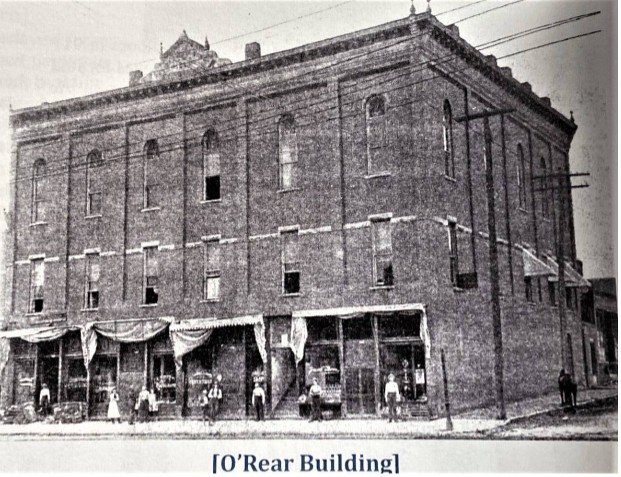
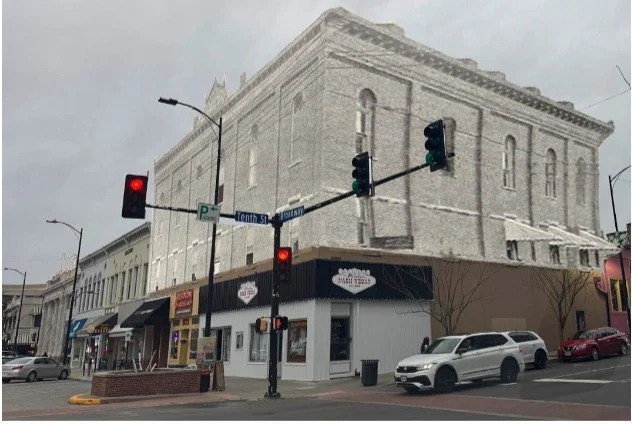
Historical photo courtesy of the Daniel Boone Regional Library; 2. Ghostly image of the original upper stories of the O’Rear building superimposed on the current remaining structure, courtesy of David Spear.
Today at the northwest corner of Broadway and 10th Street stands the first floor of the O’Rear building. The building was named for Miss Emma O’Rear (1824-1898), who had a residence and millinery shop on this corner before the O’Rear building was constructed around 1895. It originally was an impressive three-story building and a classic example of the brick commercial structures that defined Columbia’s business district during the late 1800s. The third floor sported a ballroom and had tall arched windows with art glass in each arch.
The building was an established landmark in Columbia and became a prominent part of the Broadway streetscape. Eventually the building fell onto hard times. It partially burned in the 1930s, was remodeled, and the second and third stories were removed in October of 1963. Today the sills of the second story windows are all that remain of the upper stories. Although the building doesn’t have Columbia’s “Most Notable Properties” award, it is a contributing property within the Downtown Columbia Historic District, which is listed on the National Register of Historic Places.
The building is perhaps most notable for its role in establishing the city’s public library system at the turn of the 20th century. The modern library partly owes its existence to the Tuesday Club, a women’s literary and cultural society that championed the cause of public libraries at the turn of the 20th century.
Columbia Free Library: Between 1899 and 1901, a room in the O’Rear building served as the home for the Columbia Free Library. This institution was established and managed by the Tuesday Club, a philanthropic group of women that operated the library until 1919. The Tuesday Club of Columbia, organized on January 17, 1899, was one of the city’s first women’s clubs. It was founded by 67 prominent women leaders with the primary goals of intellectual advancement and community philanthropy. The club is most celebrated for establishing Columbia’s first book-lending library, which eventually became the Columbia Public Library.
O’Rear Building: The group established the Columbia Free Library in 1899, renting space in the O’Rear Building to house their first collection. When the nearby Haden Opera House at Ninth and Broadway burned down in 1901, many of the library’s furnishings and materials were damaged so the library was relocated to the Normal Academy at the southeast corner of Cherry and 10th Street.
Nomadic Years: Lacking stable funding, the library moved frequently, occupying spaces in the Normal Academy, the Whittle Building, the Gordon building, the Stephens Endowment building, a jury room in the Old Boone County Courthouse and finally the Guitar building.
Suffrage and Success: After a tax levy failed in 1917, the library finally secured public funding in 1922 - the first year Missouri women could vote on the issue. The levy passed by 643 votes, marking its birth as a tax-supported institution.
SOURCES:
BOONE COUNTY HISTORY & CULTURE CENTER (BCHCC) ARCHIVES:
The center maintains the Westhoff, Blackmore, and Holborn photography collections, which provide the visual timeline of the building’s architectural changes.
THE STATE HISTORICAL SOCIETY OF MISSOURI (SHSMO):
Tuesday Club Records (Collection C2162): This collection includes minute books from 1899 to 1977, scrapbooks, and membership lists. These records document the club’s decision to rent the O’Rear building and their lobbying efforts for the 1922 tax levy.
Missouri Digital Newspaper Project: Archival issues of The Columbia Missouri Statesman and The Columbia Tribune provided contemporary accounts of the O’Rear building’s construction in 1895 and its subsequent “modernization” (the removal of upper stories) in 1963.
NATIONAL REGISTER OF HISTORIC PLACES (NRHP):
The Downtown Columbia Historic District Registration (2006) and the West Broadway Historic District documents provide technical details about the building’s architecture and the history of the landowners (the O’Rear family).
DANIEL BOONE REGIONAL LIBRARY (DBRL) LOCAL HISTORY COLLECTION:
The library’s own internal history archives document its “nomadic years”. This includes records of the transition from the Tuesday Club’s private “Free Library” to a public regional system.
CoMo Preservation is devoted to helping homeowners, landlords, and institutions prevent the destruction of historic architecture. Original period styles might be replicated but will forever lack the social history of authentic structures. Preserving historic places and spaces gives people a sense of place and boosts Columbia’s economy. You can get involved by volunteering, signing up for our mailing list, attending an event, becoming a member, or donating.
