
Avenue of the Columns: Part One of a Four-Part Series
The Avenue of the Columns is the stretch of 8th Street from the old Boone County Courthouse columns on the north to the old Academic Hall columns of Mizzou on the south. Columbia’s first mayor, William Jewell (1789-1852), is credited with the original planning that aligned the 8th Street axis between the University and the Courthouse. While this stretch 8th Street was known colloquially as the “Avenue of the Columns” for many years, the name didn’t become official until December 6, 1977, when the Columbia City council approved the designation of 8th Street from Walnut Street to Elm Street as the “Avenue of the Columns”.
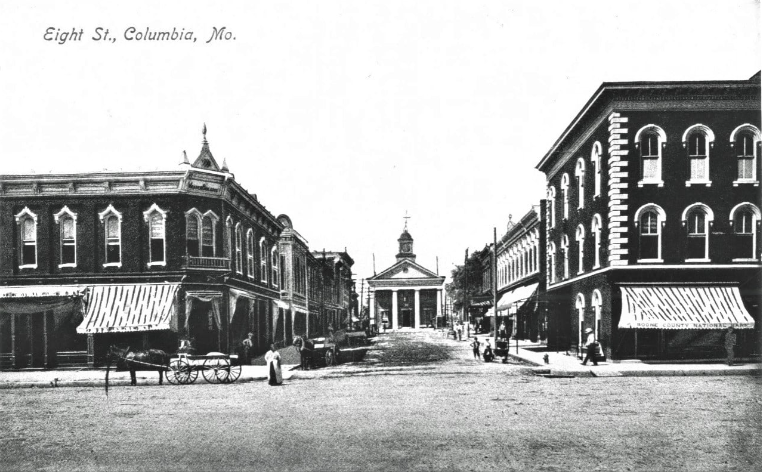
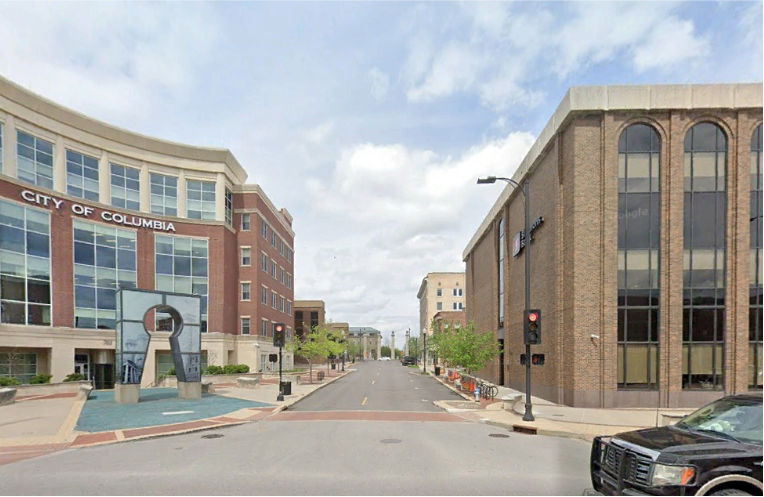
Image 1: Circa 1900 postcard of North 8th Street courtesy of the State Historical Society of Missouri; image 2: courtesy of Google Earth.
The block of the Avenue of the Columns between Walnut Street and Broadway was also known as Court or Courthouse Street back in the day. The four Doric columns at the head of the intersection of Walnut and North 8th Street are the remains of Boone County’s second courthouse demolished in 1909. The second Boone County Courthouse built in 1847 was ultimately demolished because the county had outgrown it, but its destruction was a point of significant community tension. Over its 60-year lifespan, the building had suffered several small fires and was increasingly viewed as unstable and antiquated. It had no indoor plumbing. As Columbia grew, the courthouse could no longer accommodate the expanding administrative and legal needs of the county. The county originally intended to level the entire site; however, the citizens of Columbia staged a public outcry to save the four Doric columns.
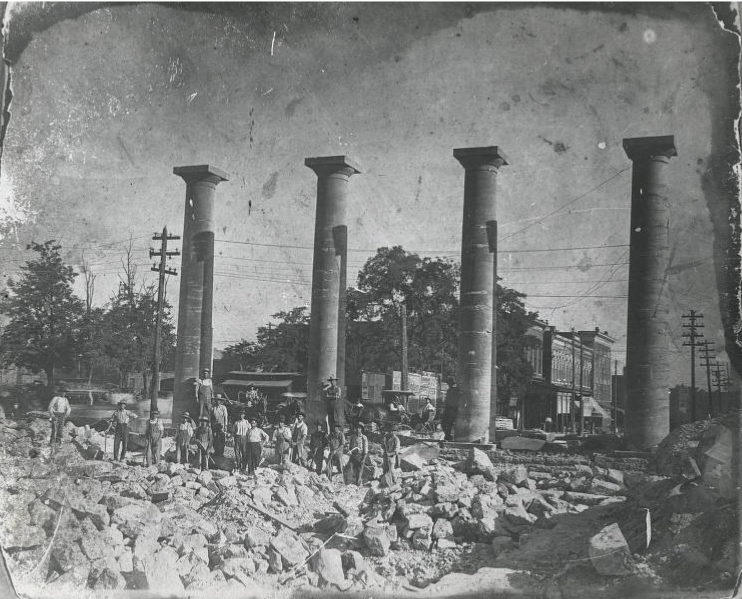
1909 photo of the courthouse columns courtesy of the State Historical Society of Missouri
The 1883 Sanborn Fire Insurance Map of Columbia shows a large two and a half story wooden structure labeled the Planters Hotel on the southeast corner of Walnut and 8th Street. The Planters Hotel was a hub for travelers coming off stagecoaches and early rail lines in Columbia. It was renamed the Hotel Columbia by 1895. To the south was a two-story brick grocery store that soon became a bakery/confectionery. It is the only 19th century building left standing on the east side of this block of 8th Street.
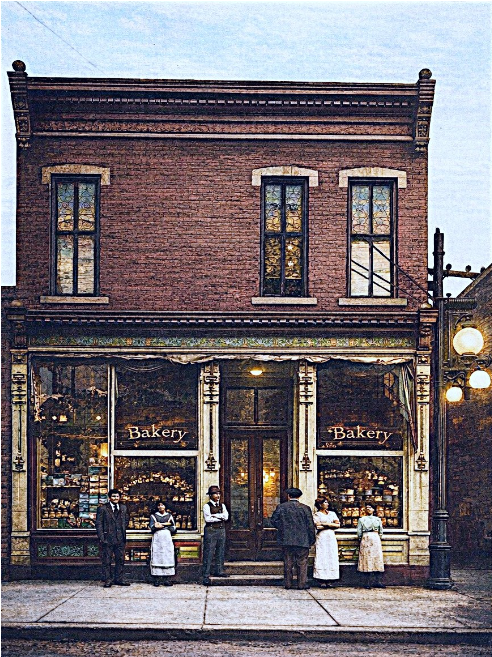
Photo from the 28 May 1915 Columbia Herald-Statesman, colorized by ChatGPT
There was an alley on the south side of that grocery store/bakery and on the south side of the alley was another two-story brick building containing a grocery store, a dry goodsstore and a clothing/tailor shop. At the northeast corner of 8th and Broadway stood a three-story Italianate brick bank building, the original location of the Boone County National Bank. This structure hosted the bank until 1917 when the business moved across the street after building its present structure out of beautiful Missouri Carthage limestone on the southwest corner of 8th and Broadway. The bank traded locations with Gillespie’s Drug Store. The Planters/Columbia Hotel was gone by 1902 according to Sanborn Fire Insurance Maps but the rest of the brick buildings south to Broadway were still standing, containing a bakery, a grocery store, a furniture store, a drug store and the Boone County National Bank.
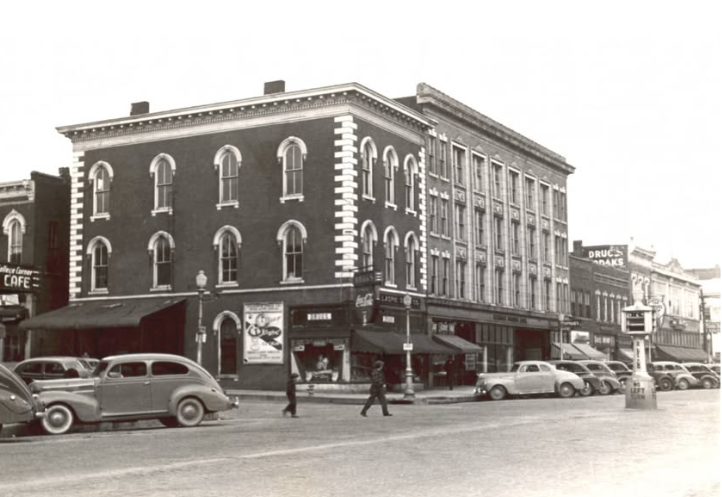
1941 photo of the northeast corner of 8th and Broadway courtesy of the State Historical Society of Missouri
By 1912, Columbia’s first skyscraper, the Guitar building, stood at the southeast corner of Walnut and North 8th Street in the same location as the former Planters/Columbia Hotel. The Guitar building, which is still standing today, is a five-story buff brick Classical Revival style structure built from 1910 to 1911 by the Guitar brothers, John H. Guitar (1872-1962) and Edward H. Guitar (1876-1959), although the brothers ran out of funds when work had only reached the second floor and had to obtain a loan from banker William T. Conley (1875-1953) to complete the building.
At the time it was built, the Guitar Building was part of a competitive trend in Columbiato build taller and more modern structures. To achieve its height, one of the Guitar brothers reportedly traveled all the way to Philadelphia to secure the necessary steel, which was in short supply at the time. It was a bold statement for a town that was still largely composed of two-story frame and brick storefronts. The building was designated as one of the city’s Most Notable Historic Properties by the Columbia Historic Preservation in 2003 and is a key part of the Downtown Columbia Historic District.
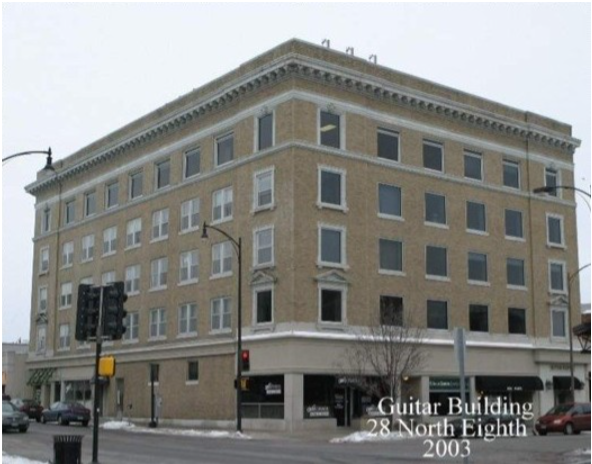
Photo courtesy of Columbia’s Historic Preservation Commission
In 1973, the three-story Italianate brick building at the northeast corner of North 8th Street and Broadway was bulldozed along with the First National Bank & Trust, the descendant of the Exchange National Bank, to the east of it. A new First National Bank & Trust building was erected in August of 1975 at that location. Additional stories were added to the bank in 1987 and it officially became the Landmark Bank in 2009. Landmark Bank was acquired by Simmons Bank in 2020.
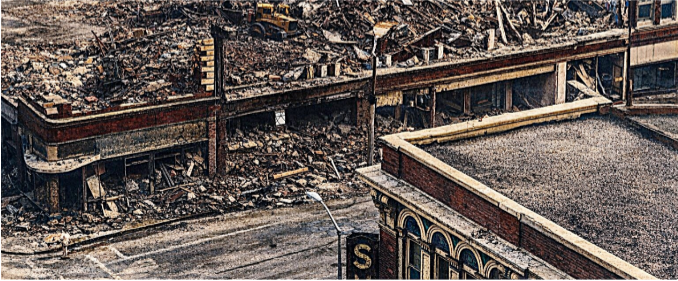
Photo of the northeast corner of 8th and Broadway courtesy of the Columbia Daily Tribune, 11 September 1973, colorized by ChatGPT
None of the original buildings on the west side of North 8th Street between Broadway and Walnut remain today. They have been replaced by a parking garage and the new section of Columbia’s City Hall. However, the 1883 Sanborn Fire Insurance Map reveals a densely packed corridor where commerce and community collided. From Walnut heading south to Broadway, the block was a bustling parade of 19th-century life: the Central Hotel, a grocery, billiards hall, hardware store, and even a combined grocery and printing shop.
Continuing toward Broadway, one would pass a tin shop, a restaurant and harness maker, two saloons, and yet another grocery and harness shop before reaching the final corner grocery fronting Broadway. With such a concentration of food merchants, it is no surprise that this block of 8th was known as "‘Grocery Row.’ Almost entirely composed of two-story brick structures, this block represented the solid, industrious heart of early Columbia.
According to Sanborn maps, by 1890 three frame buildings that had survived in the early eighties were replaced by more permanent two-story brick structures. However, this growth came with a lull; two of these new brick buildings sat vacant, and a former saloon had transitioned into a billiards hall. This shift in commerce, coupled with the Herald Publishing Company’s move into the old Central Hotel, signaled that the street was giving way to a new professional identity. The former Central Hotel at the southwest corner of Walnut and North 8th Street had been remodeled and now housed the Herald Publishing Company’s Missouri Statesman newspaper and was called the Statesman building.

Photo from the 20 October 1893 Columbia Missouri Herald.
By the 1950s, the west side of North 8th Street was still known as ‘Grocery Row.’ King’s Market was at 7 North 8th Street, Temple Stephens was at 21 North 8th, and Barney Stephens was on the corner in the three-story Statesman Building (later known as the Flora Building) which was originally the 1880s Central Hotel. The Downtown Tobacco Store was at 11 North 8th , Fred Dawson’s Shoe Repair was at 13 North 8th , the Boone Theatre was at 15 North 8th , Midwest Auto was at 17 North 8th , and the Lobby pub was at 19 North 8th.
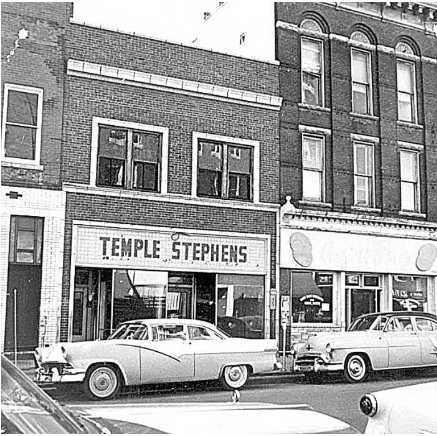
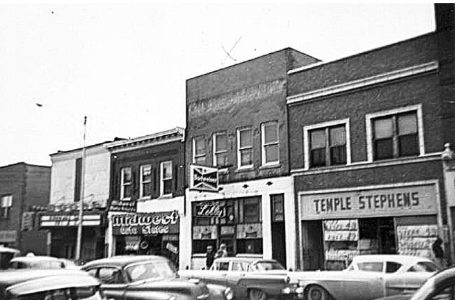
Photos courtesy of the State Historical Society of Missouri.
Finally, in 1959, most of the old 19th century brick buildings on the west side of North 8th Street between Walnut and Broadway were razed to make way for a parking lot.
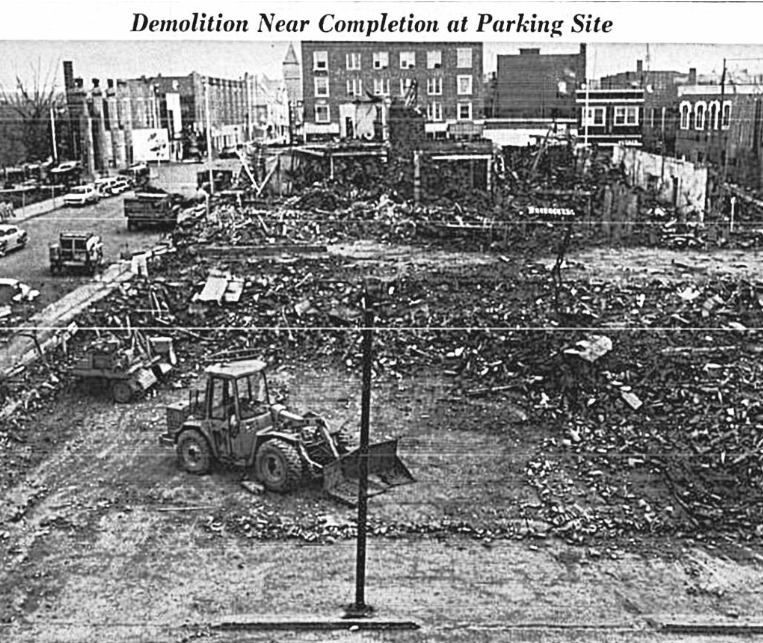
Photo courtesy of the Columbia Daily Tribune, 4 January 1960
Standing today at the intersection of 8th and Broadway looking north, one can see the stark contrast between the few old structures that have survived and those that fell to the wrecking ball. The loss of historic brick storefronts serves as a poignant reminder of why the ‘public outcry’ for the courthouse columns was so vital. The transformation of this block—from the bustling 19th-century hotels and shops to the modern parking garage and vertical expansions of the late 20th century—reflects Columbia’s constant tension between progress and preservation. While much of the original brick-and-mortar landscape has been replaced, the salvaged courthouse columns and the enduring Guitar Building remain as sentinels of the past. As we continue our journey south along the Avenue of the Columns in the next installment, we will see how the first block of South 8th Street evolved into a sophisticated center of finance and culture, anchored by the iconic institutions that still define our downtown skyline.
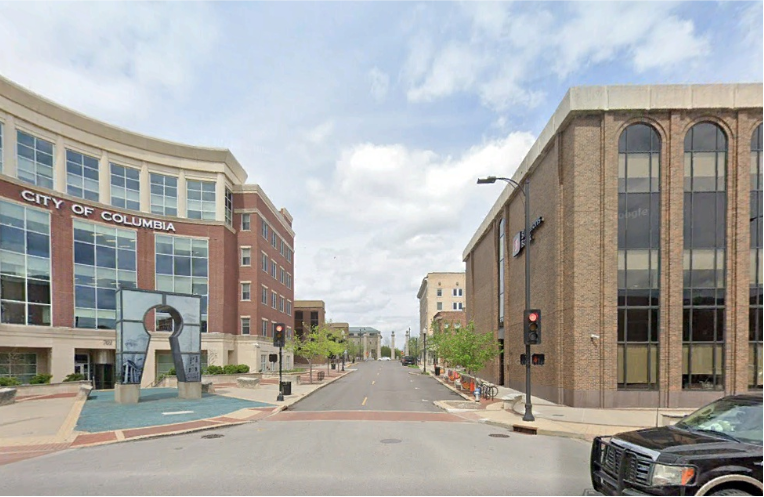
Image courtesy of Google Earth.
Sources:
1978 Historic Inventory of Columbia, MO
Columbia Historic Preservation Commission
State Historical Society of Missouri
Sanborn Fire Insurance Maps
Newspapers.com
Ancestry.com
Findagrave.com
Google Earth
CoMo Preservation is devoted to helping homeowners, landlords, and institutions prevent the destruction of historic architecture. Original period styles might be replicated but will forever lack the social history of authentic structures. Preserving historic places and spaces gives people a sense of place and boosts Columbia’s economy. You can get involved by volunteering, signing up for our mailing list, attending an event, becoming a member, or donating.
