
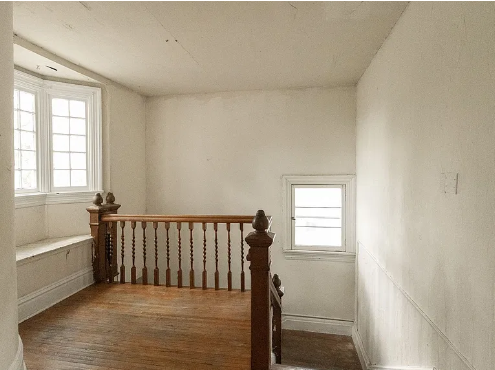
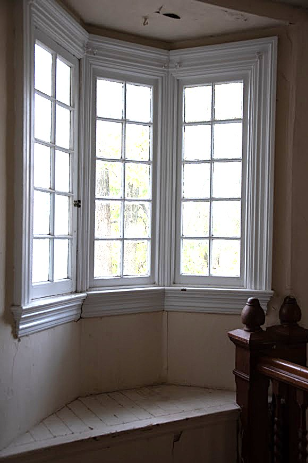
When a historic property confronts the threat of demolition, the bricks and mortar tell only half the story. At 116 South College Avenue, a cross-gable frame Queen Anne style house with its distinctive flared gables, skirted roof, wrap-around front porch and second-floor stair-landing bay window has stood as a silent witness to a century and a half of Columbia’s academic and social life. Thanks to archival research and a fascinating 1991 column by Francis Pike of the Columbia Daily Tribune, we can finally piece together the full narrative of this remarkable site.
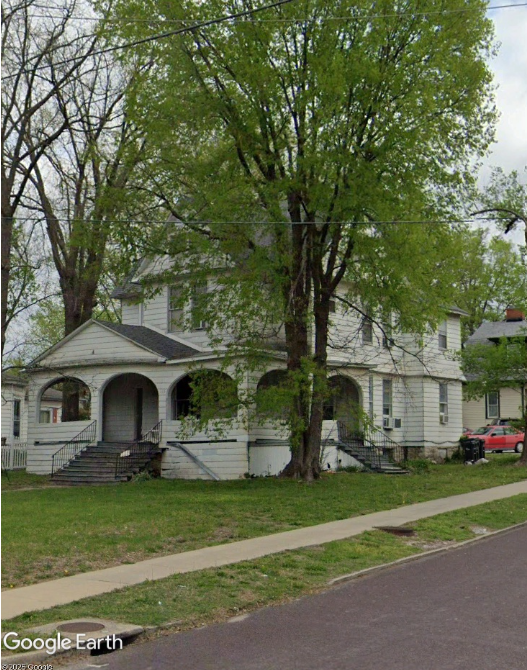
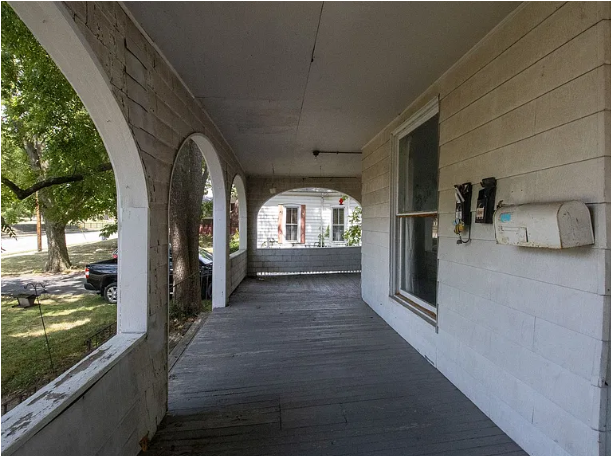
(Photos courtesy of Google Earth and Stephen Bybee)
From 120 Acres to Shields’ Eastern Addition
Long before a student ever walked up its steps, the land beneath 116 South College Avenue was part of a sprawling 120-acre tract purchased by Henry Cave Sr. (1769-1847) from the Franklin, Howard County land office on August 20, 1824—back when Columbia was just four years old and centered around the Flat Branch area. Over the decades, portions of Cave’s land were divided and sold. By the 1870s, James (1832-1897) and Martha Shields (1835-1910) had acquired acreage on the east side of today’s South College Avenue and subdivided the land as Shields’ Eastern Addition dated 10 January 1872. In October 1876, the Shields sold lots 1, 5, 6, 8, and 9 to a group of twelve family members, who later sold Lot 9 (where 116 South College stands today) to John (1820-1895) and Mary Horner (1827-1885) for $125.
(Photo courtesy of Stephen Bybee)
The Horners and the Birth of the House
The Horners built a small house on the lot in 1878, which they sold a year later to Sarah Horner Dameron (1814-1895) for $1,000. Following her estate’s probation, builder James Fay (1852-1952) purchased the property in 1895, selling it to George Henry Bingham Rollins (1852-1915) in April 1896. Rollins made substantial improvements before selling the home on January 25, 1899, to Verna (1863-1962) and Professor Frederick Hicks (1863-1953) for $5,000. Dr. Hicks was a professor of political economy at Mizzou. The Hicks held the property for a little over a year before selling it on June 15, 1900, to a man whose name would forever become linked to the property: University of Missouri German Professor Benjamin Franklin Hoffman (1860-1940).
(Photo courtesy of Stephen Bybee)
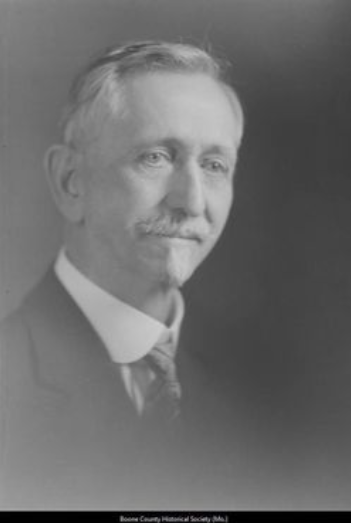
The Hoffman Era: Faculty, Students, and High Society
Professor Hoffman, his wife Ida (1870-1933), and their children Hazel (1896-1983), Frank (1898-1957) and Dorothy (1914-2003) made 116 College Avenue their home beginning in 1900. During the early 1900s, the house functioned as an intellectual and social hub. Early Mizzou student rosters and summer school records show that Professor Hoffman rented rooms to university students—including future dean William G. Bek (1873-1948) and Charles Knox Martin (1881-1965), who became a prominent Springfield, Missouri, insurance man and founder of Martin Motors Company.
As the years progressed, the house welcomed elite visitors, including former Missouri Governor Lon V. Stephens’ sisters and visiting ministers. Porch parties were held on the expansive veranda because indoor parlors would quickly grow warm and stuffy by mid-morning during the summer. Holding events on the spacious front porch provided a light, cool, and airy atmosphere for entertaining, bridging the gap between indoor entertaining and the outdoors. This neighborhood was the most exclusive one in Columbia in the early part of the 20th century.
(Photo courtesy ofthe Boone County History and Culture Center)
The Major 1928 Remodeling
According to Pike’s historical account, Professor Hoffman undertook significant remodeling of the house in 1928. Two bedrooms were added, a brand-new kitchen was constructed out of an open back porch which was enclosed, a pantry was made into a half-bath and an outdoor stairway leading to the second floor was also enclosed. The construction work was so extensive that during the summer of 1928, the Hoffmans had to board across the street for meals and sleep at neighboring homes on nights when the plumbing was out of commission!
Transition to Apartments and Later Decades
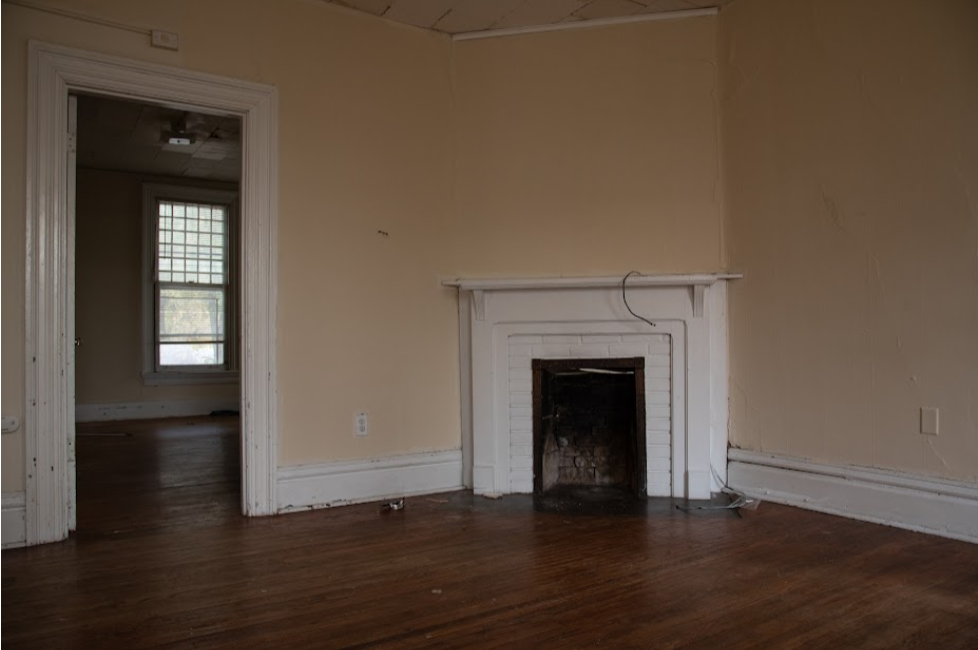
Following Ida Hoffman’s passing in 1933, Professor Hoffman sold the house on June 2, 1937, to Paul S. Weaver (1907-1977) and James H. Adair (1909-1999), both faculty members at Stephens College. Hoffman moved to the Sampson Apartments on Hitt Street, while Weaver and Adair set about dividing the historic home into separate apartments, creating the multi-unit layout that generations of Mizzou students (including local photographer and preservationist Stephen Bybee in the 1990s) would come to know. Over the next several decades, the directory and deed records show a steady rotation of residents and owners—passing through the hands of the Waite, Deicke, Artley, and Hert families before John King purchased it in 1963, and eventually coming down to its recent ownership.
(Photo courtesy of Stephen Bybee)
Why Preservation Matters and what comes next
Today, as 116 S. College Avenue faces imminent demolition due to city officials concluding the structure uninhabitable from critical structural issues, this rich tapestry of early Mizzou boarders, turn-of-the-century social gatherings, and architectural craftsmanship reminds us what is at stake. While the building itself may not be able to be saved, the preservation community has stepped in to ensure its story and materials live on. Following an initial walk-through by preservation advocates, including a CoMo Preservation board member and architecture student, who noted severe wall problems tied to failing foundation issues, Como Preservation requested salvage rights. Thanks to these efforts, architectural artifacts will be rescued so at least a portion of the historic fabric is saved from ending up in a landfill. CoMo Preservation continues to document every layer of the site’s history, ensuring that the physical and historical legacy embedded in these walls is preserved for Columbia long after the heavy machinery clears.
Sources:
Francis Pike. “Whatever Happened To The Horner-Hoffman House?” Columbia Daily Tribune, January 13, 1991.
Stephen Bybee, photographs of 116 S. College Ave, 2026, collection of the author.
Google Earth.com
CoMo Preservation is devoted to helping homeowners, landlords, and institutions prevent the destruction of historic architecture. Original period styles might be replicated but will forever lack the social history of authentic structures. Preserving historic places and spaces gives people a sense of place and boosts Columbia’s economy. You can get involved by volunteering, signing up for our mailing list, attending an event, becoming a member, or donating.
