
North Eighth Street: A Race Against The Clock
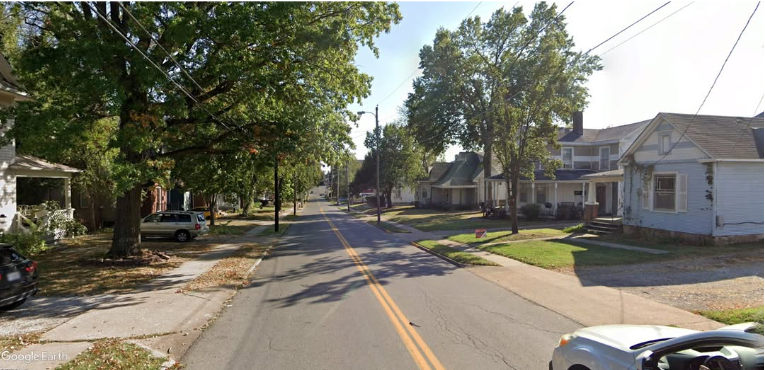
(Above: View from Google Earth looking south down North 8th Street)
Columbia College has plans to demolish most of the homes on the west side of North 8th Street in the 400 block, which is just south of Jefferson Middle School. This will leave only one home left standing on the west side of this section of North 8 th Street and Columbia College says it has no current plans to redevelop these properties.
Columbia College has owned these properties since October of 2019 and has been using them as rental properties. Columbia’s Historic Preservation Commission voted to delay the issuance of demolition permits for 45 days, but that delay period has now expired and the city has no further authority to prevent the demolitions. Current city policy limits what officials can do to prevent demolitions.
This block of North 8th Street was subdivided by Nathaniel Warfield Wilson (1811-1890) as Wilson’s First Addition on July 1, 1854. It contained eight one-acre lots arranged on either side of a road that Mr. Wilson named Wilson Street. The name was eventually changed to North 8 th Street. The 1908 Sanborn map of Columbia shows the west side of North 8th Street between Lyons Street and Rogers Street fully developed with the current existing houses and there are references to these houses in local newspapers as early as 1901.
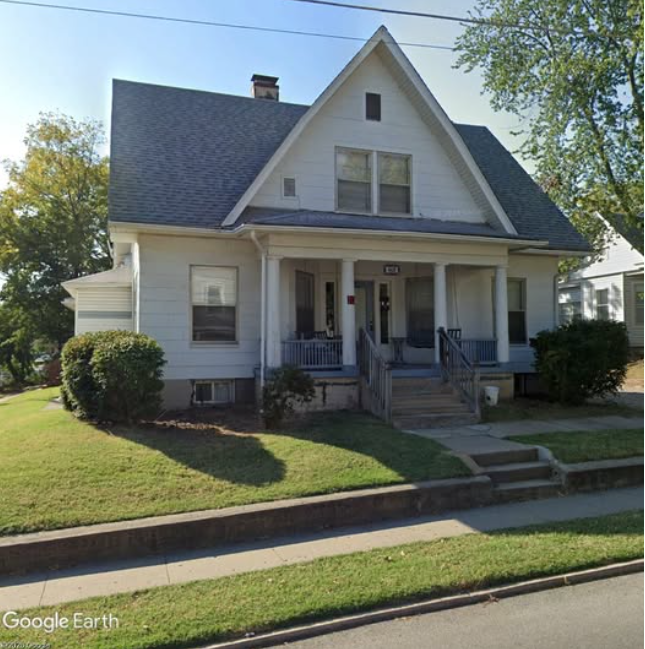
(Photo of 401 N. 8th St., courtesy of Google Earth)
This house at the northwest corner of North 8th Street and Lyons is one of the houses scheduled to be demolished by Columbia College. It is a notable example of Transitional Free Classic Queen Anne architecture. Built on a sturdy, square footprint, it features a complex cross-gabled roof and a unique recessed entry loggia - a design choice that adds significant depth and character to the facade. The porch, supported by Classical Doric columns, represents a shift in Columbia’s early 20th-century taste from ornate Victorian trim toward more refined, Greek-influenced elements.
Far from being a “shack,” 401 North 8th shows clear signs of its original early 1900s craftsmanship. The white lap siding and coordinated Doric columns suggest a house that was built with pride. Note the subtle taper of the columns on the front porch - a classic architectural detail designed to create a pleasing visual perspective. It’s a rare surviving example of the transition from Victorian whimsy to Classical order in Columbia.
In 1910, the widow Nettie Hunt was living in this house at 401 North 8th Street. Her husband was George H. Hunt who died suddenly at his home on 2 July 1893 at the young age of 40. Mr. Hunt had been at work in his shoe shop, and his death was a sad shock to his many friends. He was born in St. Louis in 1853 but had been a respected citizen of Columbia for years. He served as a member of the city council in 1892 and had been prominent in Odd Fellow circles.
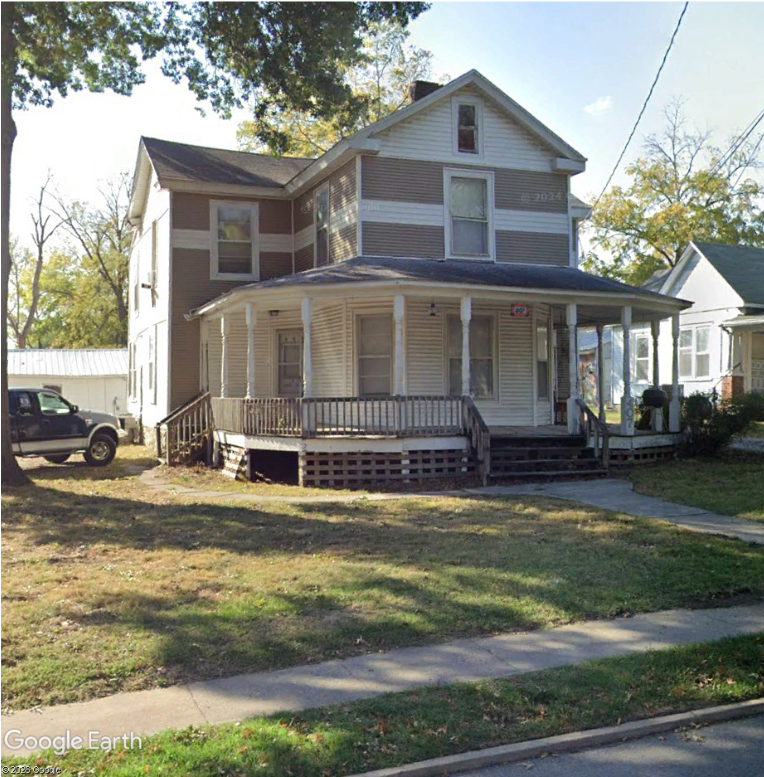
(Photo of 407 N. 8th St., courtesy of Google Earth)
This house at 407 North 8th Street is also scheduled to be demolished by Columbia College in the near future. It is a large, imposing, two-story Folk Queen Anne house characterized by its gabled front and wing (or ‘T-plan’) design. The symmetrical front facade and wrap-around porch with delicate turned spindle work posts are quintessential 1890s Columbia. The wrap-around porch was designed to maximize any breeze and provide a panoramic view of the neighborhood.
I believe this house was built between 1885 and 1895 by Stephen Wesley Pigg (1833 –1895). He was born and raised in Boone County. Mr. Pigg acquired Lot 4 of Wilson’s 1st Addition in 1884 from the widow Adaline French (1817 – 1898) and a blurb in the 14 November 1884 Columbia Herald-Statesman said he intended to build a house there. His obituary says he was an industrious and enterprising farmer until 1885 when he moved to Columbia and successfully engaged in the grocery business on North 8th Street. His grocery store was probably located in the same spot later occupied by Temple Stephens.
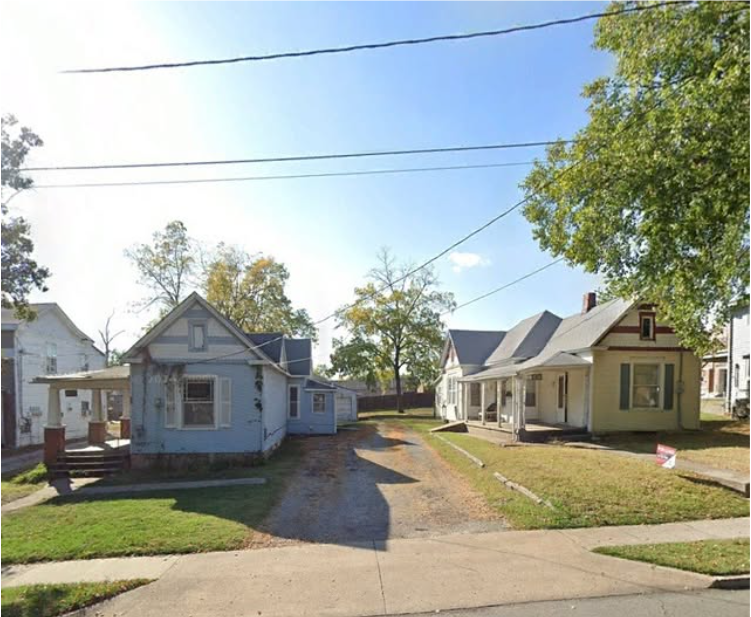
(Photo of 409 and 411 N. 8th St., courtesy of Google Earth)
Moving north along the west side of the block, we find a rare and charming sight: a pair of Queen Anne ‘Sister Cottages’ at 409 and 411 North 8th Street. The blue 409 house on the left is scheduled to be demolished by Columbia College. These 1.5-story homes are nearly identical ‘twins’, likely built by the same developer to create a uniform, upscale feel for the street. Notice the nested gables - that ‘two-stepped’ roofline that makes a cottage look grand - and the delicate gingerbread spindle work still visible in the gable peaks. They even share a driveway, a common feature from the days when one narrow lane was all that was needed for a carriage or a single Model T.
These houses weren’t just ‘built’; they were ‘designed’; with specific architectural flair like the false gables on the north side of their roofs to ensure the house looked picturesque from every angle. These ‘Sisters’ represent a time when Columbia was booming and North 8th Street was the place to be for the city’s industrious middle-class residents. It’s rare to find a matching pair like this still standing (for now) side-by-side.
According to the 1910 census, 409 North 8th Street was inhabited by Leonard and Bessie Morris, aged 29 and 22. The Morris’s were a restaurant dynasty in Columbia during the 1920s through the 1950s, owning several restaurants in the downtown area. In 1928, brothers Leonard and Earl Morris bought Booche’s and moved it to its current location. In 1930, Leonard Morris and his wife Bessie started the Ever Eat Café. Leonard passed away in 1938, but Bessie and son Ralph kept the business going. In 1953, Bessie retired, leaving Ralph to continue the business. Finally, in 1962, Ralph retired, selling the business to Dick Walls. It then became the Heidelberg. Meanwhile, Earl Morris continued running Booche’s until 1956.
SOURCES:
The State Historical Society of Missouri
Google Earth
Sanborn maps
Richard Robertson
Gariss, Brook, and Skillen, Bannack. “Columbia College set to demolish historic properties this spring”. Columbia Missourian, March 21, 2026, www.columbiamissourian.com/news/higher_education/columbia-college-set-to-demolish-historic-properties-this-spring/article_8fc4e714-045a-42f5-bd43-cdcf9c3630f5.html.
CoMo Preservation is devoted to helping homeowners, landlords, and institutions prevent the destruction of historic architecture. Original period styles might be replicated but will forever lack the social history of authentic structures. Preserving historic places and spaces gives people a sense of place and boosts Columbia’s economy. You can get involved by volunteering, signing up for our mailing list, attending an event, becoming a member, or donating.
