
Columbia’s Old I-Houses
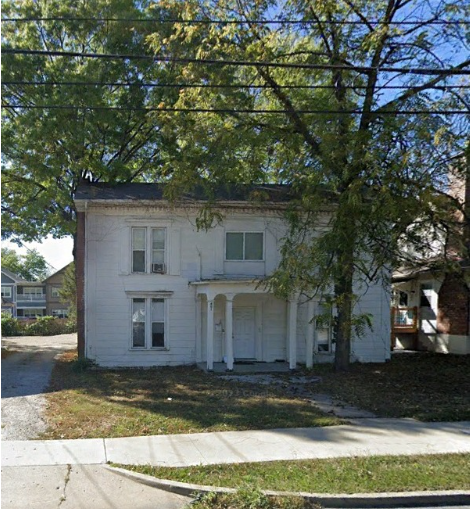
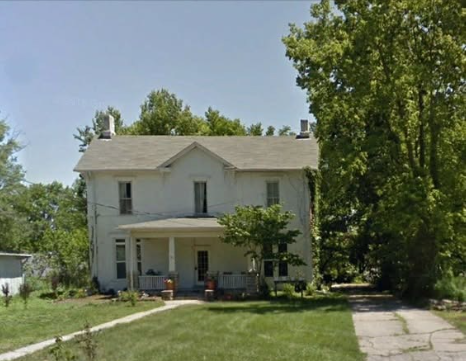
There are two I-houses in Columbia at 104 Ripley Street and
401 North College Avenue
that are over 150 years old and deserve to be preserved. The I-house is one of the most
recognizable folk architectural styles in the United States, representing a shift toward
formality and social standing in rural and small-town settings. Its popularity peaked
during the mid-to-late 19th century (1850–1890) and it became the dominant style
across the Midwest as the frontier stabilized. By the early 20th century, the style began
to fade as the more modern American Foursquare and Bungalow styles rose to
prominence.
The defining attributes of the I-house are as follows:
Symmetry: The front facade was always symmetrical, typically featuring a central door flanked by two windows on each side, with three to five windows across the second floor. They were tall, skinny, double-hung windows.
The “Rule of Two”: The houses were strictly two stories tall, two rooms wide with a central hall, and one room deep.
Lack of ornamentation: In its traditional folk form, the I-house stripped away the elaborate “gingerbread” trim or decorative brackets found in Victorian architecture. This “plainness” was often a deliberate choice to emphasize sturdiness and “honest” construction over flashy trends plus it was less expensive.
(Photo of 401 North College Ave, Columbia, Missouri. Courtesy of Google Earth)
Additions: Because the original footprint was only one room deep, many owners eventually added a rear wing (an “elbow” or “tail”) to house a kitchen, creating an L-shaped or T-shaped floor plan.
Chimneys: Traditionally, the I-house featured internal or external chimneys at both gable ends to provide heat to all four main rooms in the winter.
Cross-Ventilation: Because the house was only one room deep, every major living space had windows on opposite walls. This allowed even the slightest breeze to pass entirely through the room, sweeping out hot air in the summer.
The “Breezeway”: I-houses featured a large central hall with doors at both the front and back. When both doors were propped open, it created a “wind tunnel” effect, pulling air through the center of the house.
(Photo of 104 Ripley St., Columbia, Missouri. Courtesy of Google Earth)
SOURCES:
Google Earth
Wikipedia
Howard Wright Marshall, Folk Architecture in Little Dixie (1981)
Henry Glassie, Pattern in the Material Folk Culture (1968)
National Park Service Preservation Brief #24
National Register of Historic Places reports
CoMo Preservation is devoted to helping homeowners, landlords, and institutions prevent the destruction of historic architecture. Original period styles might be replicated but will forever lack the social history of authentic structures. Preserving historic places and spaces gives people a sense of place and boosts Columbia’s economy. You can get involved by volunteering, signing up for our mailing list, attending an event, becoming a member, or donating.
