
Avenue of the Columns: Part Four of Four
For decades, the southern stretch of 8th Street between Locust and Elm resisted the noise of the wagon factories and steam laundries to the north, remaining a quiet neighborhood of homes and stables. But in the 20th century, its DNA began to change.
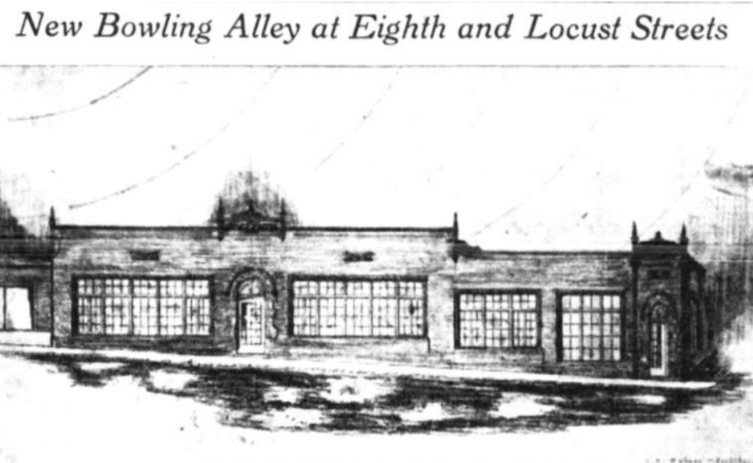
Architect’s rendering of the bowling alley’s exterior from the 8 January 1929 Columbia Missourian.
The Missouri Press Association building at the southeast corner of 8th and Locust was built in 1929 as a bowling alley named the Pla-House Recreation Bowling Parlor. It was described in an article in the 8 January 1929 Columbia Missourian as follows:
“In the playing room there will be eight alleys, lighted so that there will not be a shadow cast, and elevated spectator seats with six-foot passages from the main entrance. Behind the seats there will be an entrance into the lounge room which will have a coat room adjoining. The floor will be laid in 6 by 9-inch mine-run red tile. Besides the bowling parlor, a soda fountain and sandwich shop will be installed. The architectural effect of the exterior of the building will harmonize with that of the Missouri Theater.”
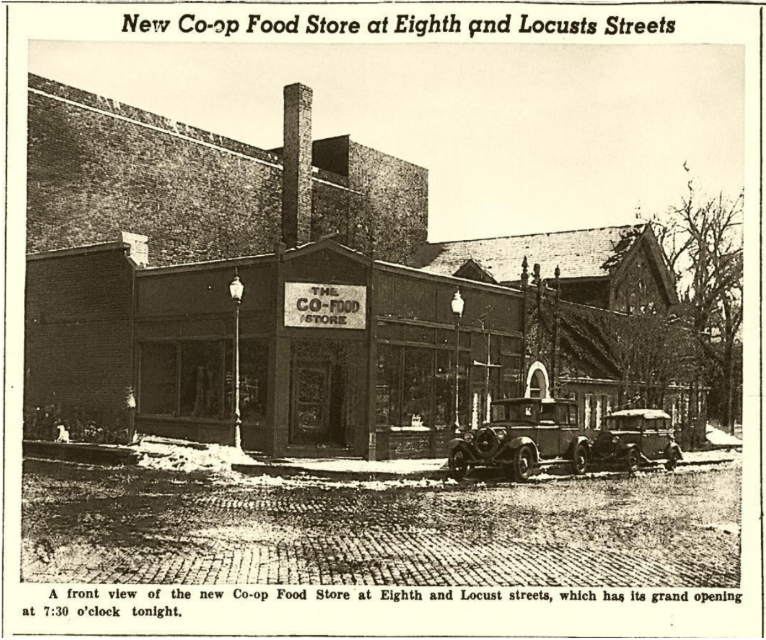
Image of the Co-Op Food Store from the 12 February 1942 Columbia Missourian.
The amusement center only lasted five years. In 1934, MFA Oil Company took over the space for general administrative offices and space to store pumps, trucks and other equipment for their 26 bulk plants all over the state. In 1940, the Missouri State Employment Service leased rooms in the east half of the building at 804 Locust. In 1942, the Columbia Co-Op Food Store leased the west half of the building at 800 Locust and in 1953 Robnett-Putnam Interiors remodeled 800 Locust extensively to contain show rooms, conference rooms, a powder room and an office. In 1964 the Missouri State Employment Service moved out of 804 Locust and a billiards parlor called Billa-Cue took over the space. Finally, in 1969, the Missouri Press Association bought the building and has been there ever since.
Although the one-story buff brick building immediately south of the Missouri Press Association building looks similar, it was not built until 1951. The first tenants were the Veterans of Foreign Wars at 210 South 8th and Witt Print Shop at 212 South 8th Street, but Bob Ghio’s Studio had moved into 210 by 1952. Bob was also the publisher of Town Life, a pictorial magazine of Columbia. Bob Ghio remained in the same location until 1965, and he was followed by a succession of businesses until the legendary Dawson Shoe Repair moved into the space in 2008 and is still there. Witt Print Shop remained in the south half of the building until 2015, and La Calle 8 Café is now in that space.
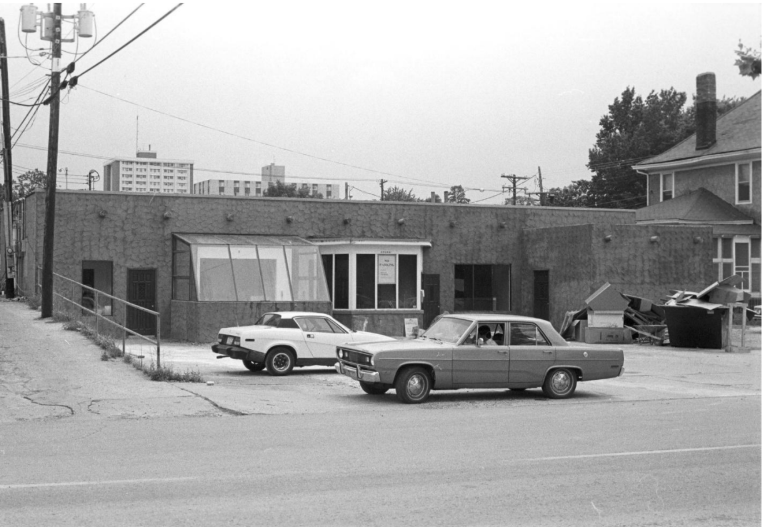
1978 photo of Los Bandidos courtesy of the State Historical Society of Missouri.
From 1951 to 1970, Carl Medley’s Auto Service was located south of the alley on the east side of South 8th Street between Locust and Elm followed by Duerst Automotive Service. In 1978, the service station was remodeled to house a Mexican restaurant called Los Bandidos which became all the rage with college students. The interior was decorated with pictures of Pancho Villa and other Mexican bandits.
After Los Bandidos closed in 2002, a succession of restaurants occupied this building including the celebrated Shakespeare’s Pizza for a short time. It is now the home of Las Margaritas restaurant, which has some big shoes to fill.
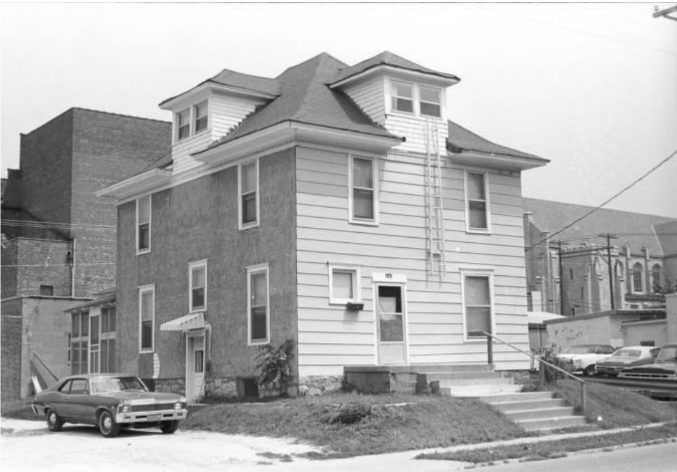
1978 photo of 803 Elm Street courtesy of the State Historical Society of Missouri.
At the northeast corner of South 8th Street and Elm Street stood a two and a half story American Foursquare house from 1906 to 1993. It was a student boarding house from inception due to its excellent location immediately north of the Mizzou campus. In 1909, Mrs. Joseph D. Wynne (1859-1934) was the landlady here. She refused to join a price-fixing scheme to raise the price of room and board that had been agreed to by 15 other landladies who kept some of the most desirable boarding and rooming houses near campus. When students found out about the scheme, they threatened to retaliate by boycotting stewed prunes and rhubarb. Today the house is gone, and the space is a parking lot.
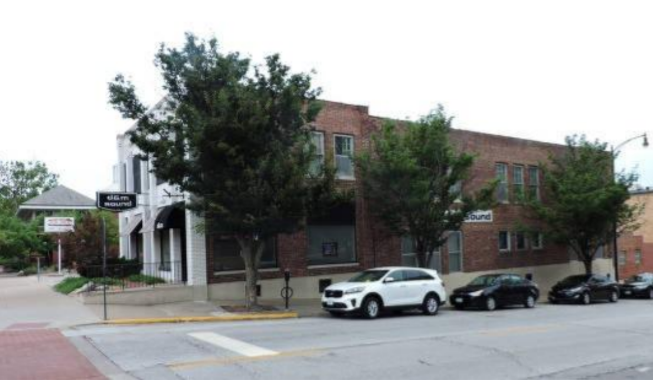
2018 photo of D&M Sound courtesy of the State Historical Society of Missouri.
At the southwest corner of 8th and Locust, the Vandiver family, who owned a large dairy farm in the vicinity of today’s Vandiver Drive, built the White Eagle Dairy plant in 1918. The building still stands today. Spaciously designed for churning milk into ice cream and butter, it is a two-story brick building with a basement. It was a state-of-the-art facility featuring a 10-ton mechanical ice machine, a tile boiler room and a massive 20-foot cooling rack towering over the roof line when it was built in 1918.
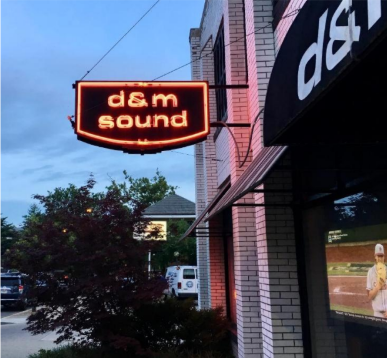
Photo of the neon D&M Sound sign courtesy of Anne K. Moore.
The building was purchased by Sherman Kelly in 1951 who converted it into Kelly Press. In 1986, the Columbia Art League bought the building from Kelly for $390,000 but were forced to default and return the building to Sherman in 1990 because they could not afford the mortgage. The president of D&M Sound, Anne K. Moore, moved D&M Sound into the building in 1991. She tuckpointed the entire building, restored the glossy brick on the front, added green space and era appropriate awnings, restored the old Kelly Press neon sign and changed it to read “d&m sound”. The original tile and brick on the first floor were also restored, as well as the original fire suppression system. Engraving plates from the 1950s were found and displayed. D&M Sound occupied the building until 2025, when Anne and her family sold the building to another local individual who hopes to further restore it.
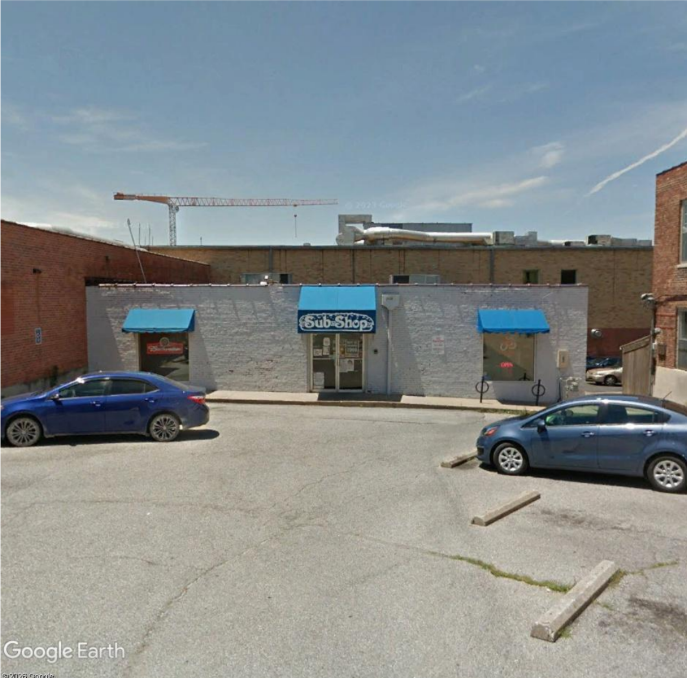
Image of Sub Shop courtesy of Google Earth.
In the past, there were two structures located immediately south of the D&M Sound building but both are now gone. One was built at the same time as old dairy plant in 1918 and was used as storage by both the dairy and its successor, Kelly Press. It was located on the south side near the back of the D&M building. In 1991, the eccentric but wildly popular Sub Shop bought the old storage building, consolidated two original stores on Walnut and Gentry Avenue and moved in, after remodeling the old building extensively. The Sub Shop went out of business in 2024, and the old building was demolished in 2025.
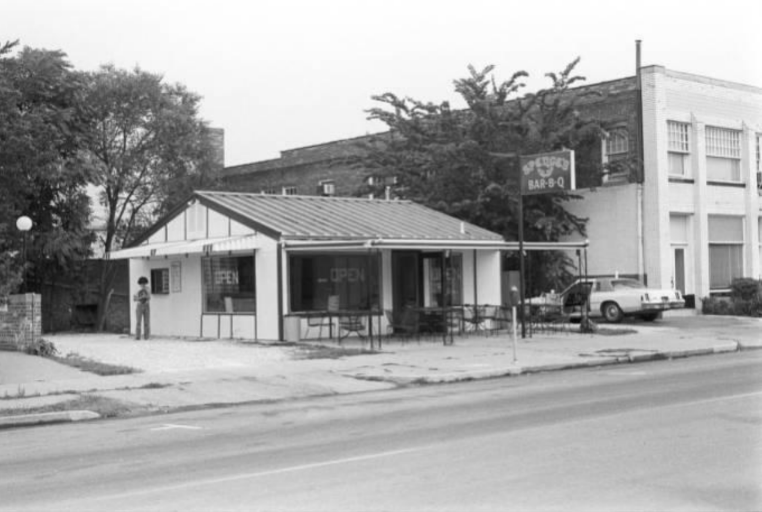
1978 photo of Spence’s Bar-B-Q courtesy of the State Historical Society of Missouri.
In 1958, a small 24’ by 24’ structure was built in front of the storage building close to the sidewalk on the west side of South 8th Street. The first occupant was the Spudnut Shop, followed over the years by other occupants including Connie’s El Sombrero and Spence’s Bar-B-Q. This structure was torn down around 1991 to provide a parking lot for the newly renovated Sub Shop in the old dairy storage building.
Continuing south to the alley on the west side of South 8th Street in 1925, we would have encountered the Columbia Bottling Plant, a beautifully engineered brick bottling works with pilastered walls and concrete floors that clinked with the sound of glass bottles being steam-sterilized and filled. Because bottling plants dealt with thousands of heavy glass bottles and massive amounts of water, concrete floors were mandatory. Pilastered walls meant the brick walls had built-in columns (thickened vertical piers) to support the roof load, allowing the interior to stay wide open for the bottling conveyor belts. From 1940 to 1951, a series of service stations occupied the bottling plant building. By 1958, the Missouri Farmers Association acquired the structure, which it used for storage. Then in 1966, the old bottling plant met the same fate as the stunning Gothic Revival style YMCA building south of it. It was demolished by MFA.
The 1906 Savitar, Mizzou’s yearbook, described the YMCA building to be erected at the northwest corner of Elm and South 8th Street as follows:
“The new home for the Young Men’s Christian Association will be well under construction by the opening of the fall semester. This will be welcome news, not only to the host of students at the University, and the people of Columbia, but to all the citizens throughout the State. This splendid four-story structure, 115 by 90 feet, is to be erected of hand-hewn native limestone and when completed will be the most attractive building in Columbia. The interior finish will be of the very best quality throughout.
"In the basement will be a swimming pool, shower baths, bowling alleys, a barber shop and lunch and dinner rooms. The first floor will include a spacious lobby, social room, game rooms, public and private offices of the General Secretary, and an auditorium with a seating capacity of from 450 to 500 people. The second-floor rooms will be given up largely to Bible classes, committees, and offices for creditable student organizations. The third floor will be devoted entirely to dormitories.
The building will be located at the north end of the main entrance of the quadrangle, the most attractive location for such a building. The cost to erect this structure, including equipment, will be $60,000. It is hoped by every student at the University that this building will be a reality before you again hear from the Association through this publication.”
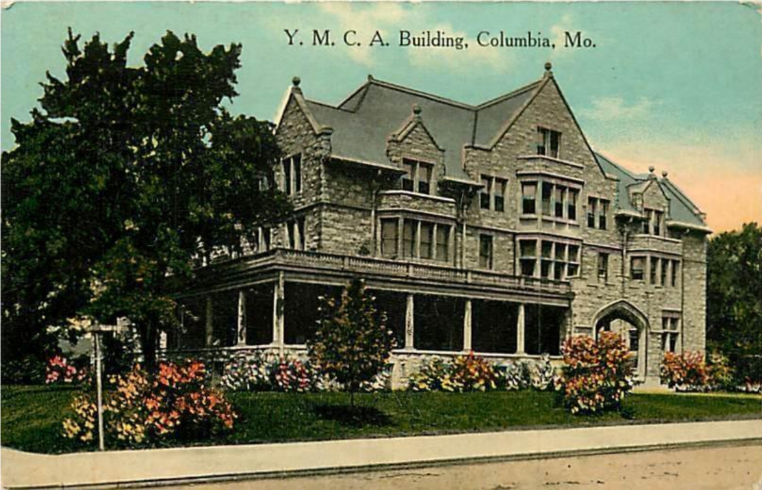
Postcard depicting the Y.M.C.A. courtesy of the State Historical Society of Missouri.
The YMCA met financial problems before and during the Great Depression, and the mansion was sold for $14,000 in 1936. It was purchased by Mr. and Mrs. Joseph Chorlton who converted it into a hotel and apartments named the Chorlton Arms. Large rooms were made into smaller rooms, providing a capacity for 75 occupants. The swimming pool was repaired and the floor in the ballroom was sanded and waxed. After World War II, when the university had a severe housing shortage, many former servicemen lived there.
The Chorlton Arms enjoyed a few successful years but was sold again in 1953 to Marvin D. “Jack” Murphy who changed the name to the Campus View Apartments. The Murphys sold the mansion to MFA in 1974. Mrs. Murphy explained, “We were both in our 70s when we sold it. At our age, we felt we should be getting rid of our responsibilities. We were hopeful that by selling it to MFA, we could keep them downtown rather than moving out of town.” An MFA spokesperson said it would have taken a small fortune to make the building safe and “We didn’t want to operate slum housing. The only value it had to us was the land.” The contractor who was hired by MFA to demolish the building lamented, “My impression, having lived in Columbia since 1939, is we have tended to neglect the landmarks in Columbia due to university and business expansion. It’s unfortunate that Columbia hasn’t done more to preserve old buildings. We could have retained the architectural character of Columbia. That was so much better than what we have now.”
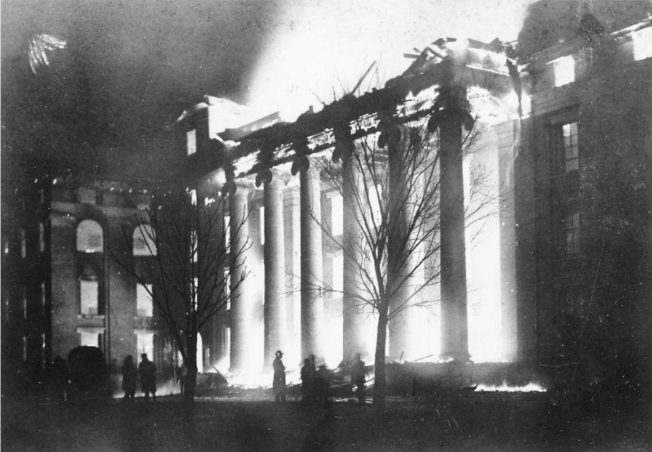
1892 Academic Hall fire by an unknown photographer, Public Domain.
Across Elm Street at the south end of the Avenue of the Columns stands the most iconic symbol of the University of Missouri, the Columns of the old Academic Hall that burned down in 1892. Along with Jesse Hall, they are one of the most photographed sites in Missouri and are a contributing structure to the Francis Quadrangle National Historic District.
In the next few months after the fire, many thought the Columns were an eyesore that obstructed the view of the new red brick buildings being constructed around the Quad, later nicknamed the Red Campus. Some thought they were structurally unsound and a safety hazard. But protests from Columbia citizens and the reassurance from an architect that the Columns were structurally sound convinced Mizzou’s president, Gideon Rothwell, and other curators to let the Columns remain. Rothwell himself famously declared, “Let those columns stand. Let them stand a thousand years.”
From the old Boone County courthouse columns, bustling hotels and grocery stores at the north end of the Avenue of the Columns, to the luxurious banking empire, elegant ten-story hotel, wagon factories and steam laundries in the middle, to the vibrant community hubs of bowling parlors, legendary sub shops, and dairy plants at the south, the Avenue of the Columns has always been the true, beating heart of Columbia’s evolution. It was a place where local entrepreneurs built dreams, where generations of Mizzou students found a home, and where architectural landmarks defined the very character of the city. When we look at the numerous parking lots that now interrupt this historic path, we are reminded of the high cost of neglect and the permanent loss of our shared identity.
Yet, as the Avenue terminates at the Francis Quadrangle, the fabled Columns of Academic Hall stand as an enduring testament to what happens when a community chooses to fight for its past. They survive today only because citizens refused to let them be treated as an eyesore or cleared away for modern convenience. As we look toward the future of the remaining historical anchors of our town, we must channel that same fierce determination. We must not let "parking lots" be the final chapter of our history. Instead, we must honor the structures that shaped us, protecting the architectural character of Columbia so that our story, too, may stand a thousand years.
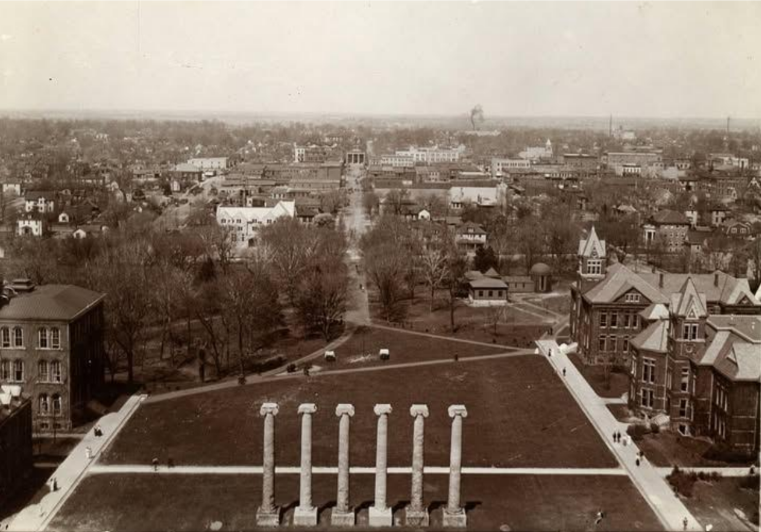
Circa 1906 photo looking north up 8th Street from the dome of Jesse Hall courtesy of the
State Historical Society of Missouri.
Sources:
State Historical Society of Missouri
Sanborn Fire Insurance Maps
The Savitar
Google Earth
Anne K. Moore
CoMo Preservation is devoted to helping homeowners, landlords, and institutions prevent the destruction of historic architecture. Original period styles might be replicated but will forever lack the social history of authentic structures. Preserving historic places and spaces gives people a sense of place and boosts Columbia’s economy. You can get involved by volunteering, signing up for our mailing list, attending an event, becoming a member, or donating.
