
Avenue of the Columns: Part Three of Four
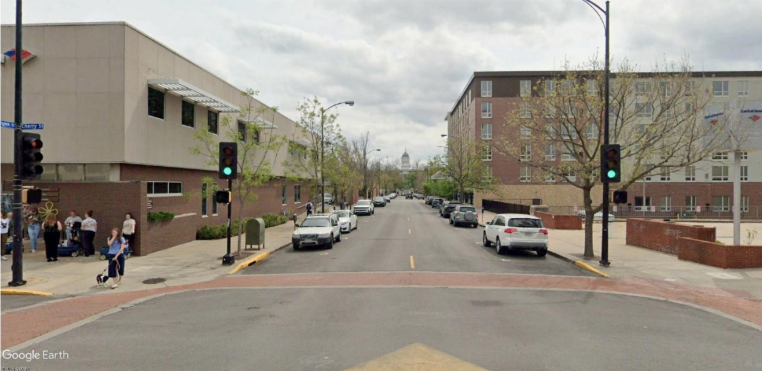
Looking south on 8th Street from Cherry Street courtesy of Google Earth.
Only one original commercial building is left standing in the stretch of South 8th Street between Cherry Street and Locust Street. This is partly due to pressure from its proximity to Mizzou. The rapid growth of the University in recent years has resulted in a proliferation of high-rise student housing near campus. It is also due to the redevelopment of a former mostly industrial block as Columbia spread south.
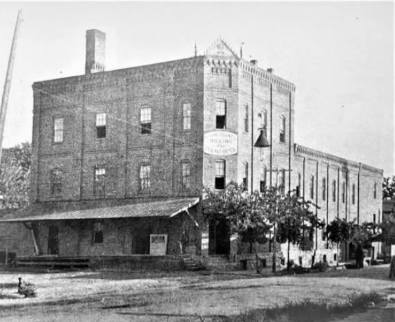
Photo of Boone County Milling Company courtesy of the Boone County Historical Society.
A large two and three-story building, home of the Boone County Milling & Elevator Company, occupied the entire southeast quadrant of South 8th Street and Cherry Street from 1862 to 1945. The building was partly frame construction until 1895 when wood was replaced by brick. Agriculture was the main business in mid-Missouri for most of its early history and grist mills were an important business in Columbia. Farmers would bring their corn and wheat to be ground into flour in Columbia’s mills.
In 1862, Robert Hudson Smith (1821-1918) acquired a steam flouring mill at the southeast corner of Cherry and 8th Street. By 1888, it was called the Columbia Flour Mills and later renamed the Boone County Milling & Elevator Company. In 1893, the share holders were cited as follows: William T. Anderson (1842-1925), David Guitar (1827-1912), James H. Waugh (1832-1901), John S. Clarkson (1829-1919), Turner McBaine (1853-1908), William A. Bright (1850-1933), Samuel A. Smoke (1863-1921), James M. Baker (1849-1936), James Rogers (1858-1925), George H.B. Rollins (1852-1915) and James C. Reid (?-1903).
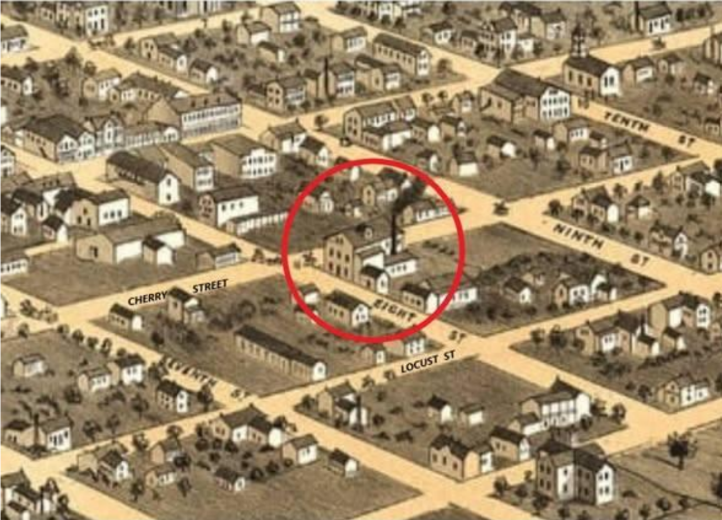
The location of the Boone County Milling building circled on the 1869 Bird’s Eye View of
Columbia, Missouri drawn by Albert Ruger, original held by the Library of Congress.
An article in the 29 September 1912 Columbia Daily Times described the business as one of the oldest, most useful and most valuable assets in Columbia. This mill piped water across downtown Columbia from Samuel’s Pond, located near today’s Paquin Street, using sycamore logs as piping. The mill suffered a devastating fire in 1892 and was rebuilt. It lasted until another fire consumed it in 1945. The corner sat empty until Columbia Savings Bank, later renamed 1st Bank of Commerce, and now named Bank of America, was built there in 1955. The milling company was a massive footprint, but so is the current bank.
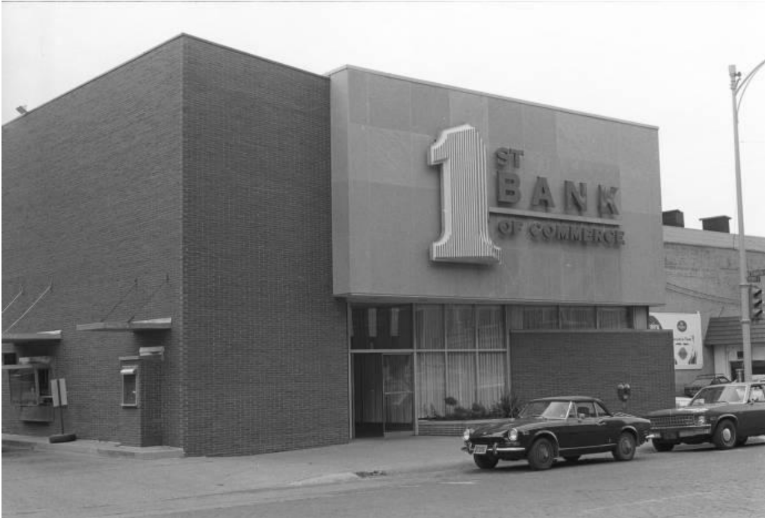
1978 photo courtesy of the State Historical Society of Missouri.
The first bank in Columbia with drive-through service, the building is a textbook example of Mid-Twentieth Century Modern 'Box' design. Unlike the mill, which used verticality to signify its presence, the bank emphasizes horizontal lines. The first story is clad in a red brick veneer, grounding the building, while the second story—which is sheathed with limestone slabs on the west side and about 38 feet on the north—juts out slightly, creating a heavy, solid appearance. It is a 'fortress' of finance, built with a utilitarian focus that contrasts sharply with the intricate industrial craftsmanship of the 19th century mill that preceded it.
1978 photo courtesy of the State Historical Society of Missouri.
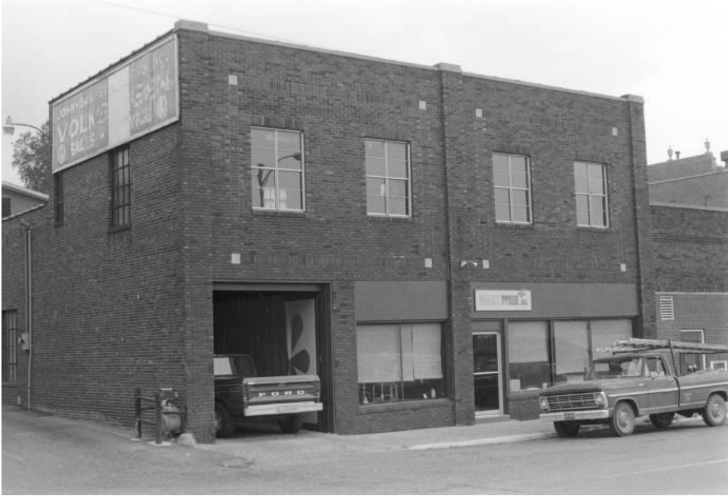
Until 1924, the southeastern quadrant of the block only contained one and two-story frame houses. By 1925, the 'Avenue' was modernizing. A two-story brick garage appeared south of the alley, featuring pilastered walls—a sign of structural and masonry skill—with a 15-car capacity and a reinforced concrete floor. It was a high-tech facility for its time and hosted various car dealerships, auto repair services and gas stations over the years. There were gas pumps at the curb! The building also served as an armory and Regional Headquarters of the 128th Field Artillery of the Missouri National Guard in the 1930s. By 1978, the building was home to Accent Press, a commercial printer. The building ended its life as an annex owned by the Calvary Episcopal Church and was torn down in 2003 to provide a parking lot for the church.
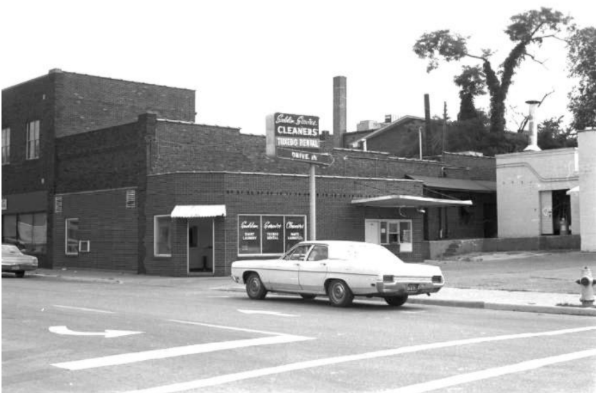
1978 photo of Sudden Service courtesy of the State Historical Society of Missouri.
A one-story brick building 25 by 62 feet in size was also built at the same time in 1925 adjacent to the south side of the garage. This structure was occupied by Sudden Service Cleaners operated by the McCluskey family from 1925 to 1946 when the McCluskeys sold the business to Walter B. March. This building is still standing and is currently the home of Tiger Cleaners. It stands as a 'lone survivor'— a remnant of a time when the buildings on this block were built with pilastered masonry and clear-span heights, designed to last for centuries.
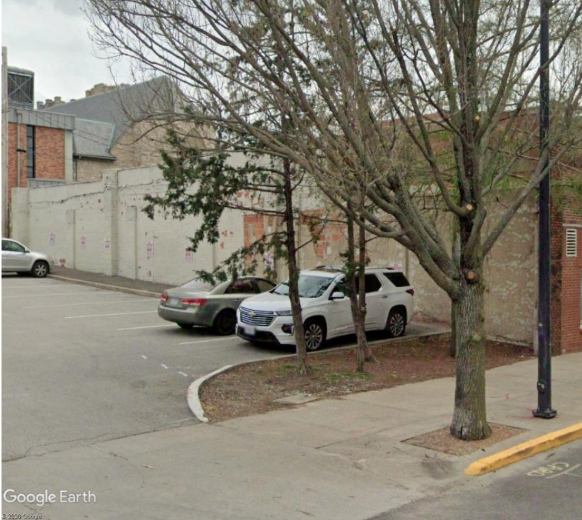
Image of north side of Tiger Cleaners courtesy of Google Earth.
Because the 1925 brick garage was demolished to create a parking lot for the Calvary Episcopal Church, the north wall of the 'Lone Survivor' (the dry cleaners) is now exposed. If you look closely at this Google Earth view, you can see the original structural columns—the ‘bones’ of the building—aligned with each stair-step of the roofline. You can even see the shorter mid-piers that reinforce the interior space. South of the Sudden Service Cleaners in 1925 stood a two-story frame house that anchored the corner of South 8th and Locust. It was one of the last residential holdouts on a block that was rapidly industrializing. Today, that corner is also a parking lot.
The west side of this block has experienced a more dramatic change than the east side. In 1883, the southwest corner of 8th Street and Cherry was a vertical factory—a three-story wagon building shop where blacksmiths worked on the ground floor while painters finished wagons on the floors above. They were powered by a steam boiler with a 40-foot iron chimney and protected by a massive gravity-fed water tank that was added by 1890. This was the 'Silicon Valley' of the 19th century—a corner of high-energy production.
By 1895, the corner had evolved into a brick-and-iron stronghold. Blacksmiths were still on the first floor, and painters were still on the second, but they had an early engine shop operating right alongside the traditional wagon works. Imagine the noise of that corner: ring of the blacksmith's anvil, the hiss of the steam boiler, and the first coughs of early experimental engines. It was a corner of pure innovation. By 1914, the southwest corner was still a marvel of vertical engineering. Merchants Delivery Company was on the first floor and a 'Mule Barn' on the second floor with a wooden ramp running almost the full width of the building for the mules’ access to the second floor. Standing on the corner of 8th and Cherry in 1914, you would have heard mule hooves on wooden planks overhead and see the 'Merchants Delivery' wagons pulling out of the first floor. It was a dense, high-functioning urban space.
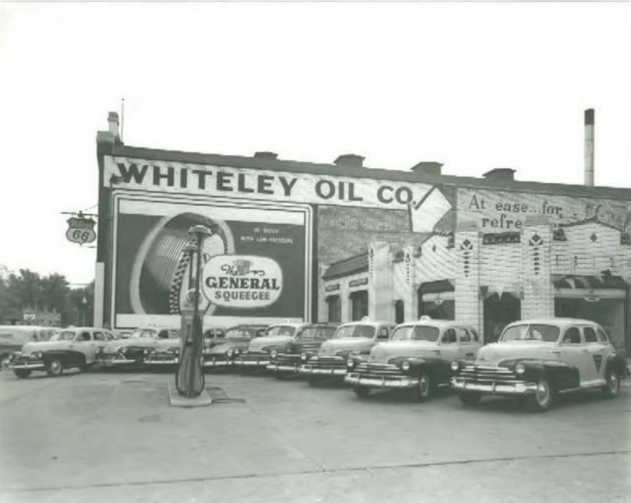
1940s photo of Whiteley Oil Company courtesy of the Boone County Historical Society.
In 1925, the same brick building at the corner of 8th and Cherry was an 'Auto Livery' and an 'Electric Battery Shop.' They didn't tear the building down when technology changed; they adapted to it. They installed a grid of wood posts to create open machine storage and used 'fire-rated wire glass' and brick-curbed openings to meet 1920s safety codes. In 1935, the old brick building was torn down to make way for a ‘modern’ service station—the last tenant was Whiteley Oil Company. By 1964, Dairy Queen had bought and remodeled the service station building. Finally, the remodeled service station was demolished in 1982 to provide parking for the bank across the street. We traded a factory, a mule barn, and even a place to get an ice cream with friends for a flat stretch of pavement.
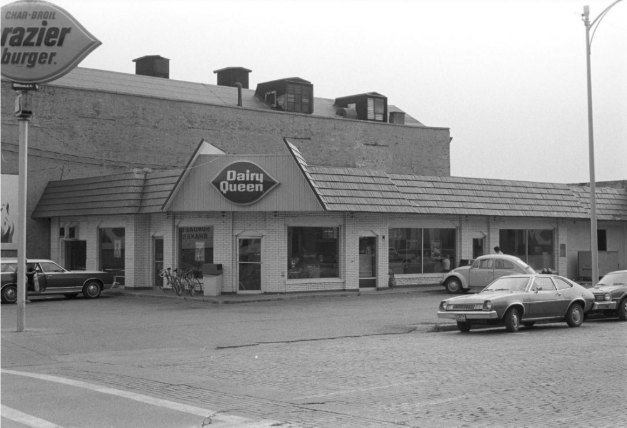
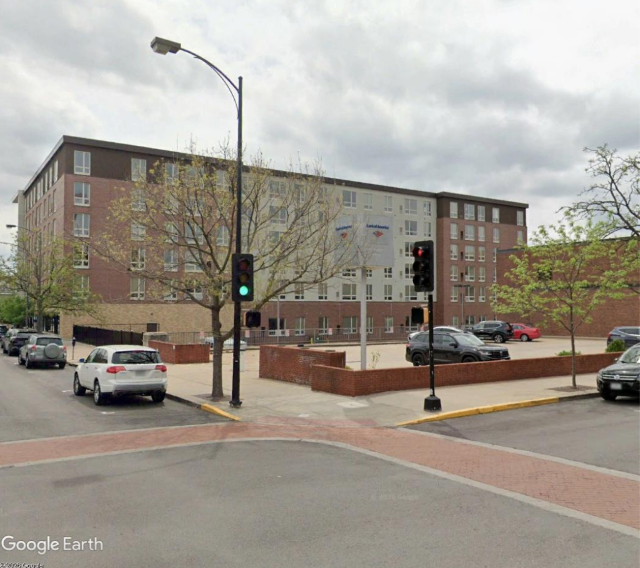
(1) 1978 photo of a Dairy Queen courtesy of the State Historical Society of Missouri; (2) Parking lot at the southwest corner of 8th Street and Cherry courtesy of Google Earth.
The lot south of the wagon factory down 8th Street to the alley hosted laundries for most of its history but today it is a sunken parking lot. In 1890 a long narrow frame building here was occupied by the Columbia Steam Laundry. By 1895 the same footprint had become a two- story brick building occupied by the Conger Brothers Laundry. Then in 1909 the Dorn- Cloney Laundry and Dry-Cleaning building was constructed at this site. Here is a description of it from the 28 August 1910 University Missourian:
“Columbia has just one laundry, but it is the largest one in the state outside of St. Louis and Kansas City. It is owned by the Dorn-Cloney Laundry Co. who also have establishments in Sedalia, Kansas City and Muskogee, Okla.
The Columbia laundry building is two stories in height with a basement under the entire building. Its dimensions are 75 by 140 feet. In the basement are the carpet cleaning department, the water softening department, the engine room and the stable. On the first floor are the offices and the laundry machinery. The second floor is used as a dance and entertainment hall.
The laundry employs fifty people the year round. Their monthly payroll is in excess of fifteen hundred dollars. All the employees are local people it being the policy to employ no foreign help wherever Columbia people can and will do the work.
The laundry is equipped to do the work of a city of twenty-five thousand people [Columbia's population was approximately 12,000 in 1910] and with the very excellent service that it is now giving its patrons, it is a source of pride to every Columbian. The Dorn-Cloney building is one that is always shown to the Columbia visitor.”
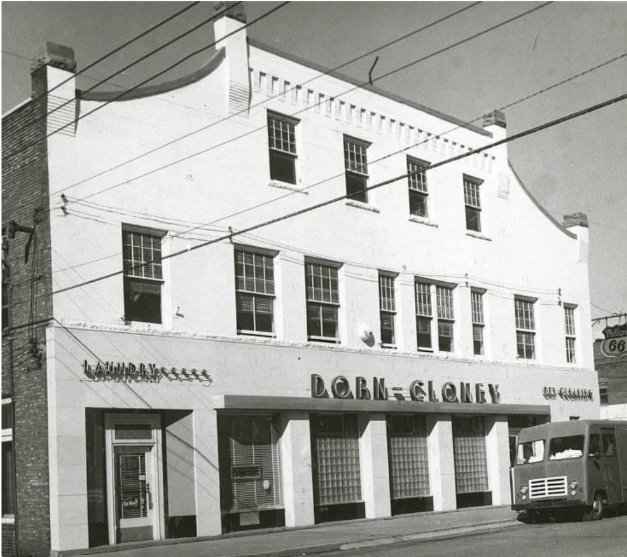
1970 photo courtesy of the State Historical Society of Missouri.
Dorn-Cloney wasn't just a business; it was a city within a building. In the basement, they softened water and stabled the delivery horses. On the first floor, they ran the most modern laundry machinery in the state. And on the second floor, the community danced and attended plays. When we look at the parking lot that sits at 115 South 8th Street today, we aren't just looking at empty space. We are looking at the footprint of a place that once employed many Columbians, supported local families over 'foreign help,' and was a 'source of pride to every Columbian.' The Dorn-Cloney building was demolished in 1979.
Continuing down the west side of South 8th Street in 1895, we would have encountered a planing mill and carpentry shop owned by Franklin Pierce Miller (1853-1923). The mill was powered by steam piped in directly from the Conger Brothers Laundry next door. That’s a level of urban cooperation and efficiency we rarely see today—a neighborhood where a carpenter’s saws were powered by the same steam that cleaned the city's clothes.
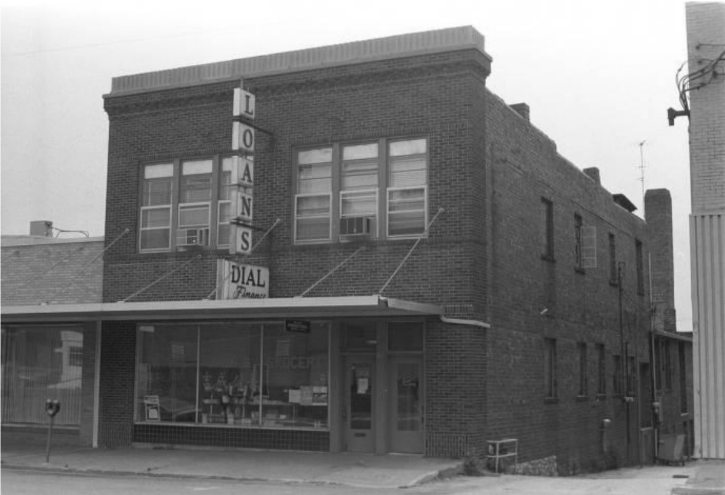
1978 photo of Dial Finance and the Lennox Apartments courtesy of the State Historical
Society of Missouri
By 1914, Mr. Miller had upgraded his humble frame shed into a two-story brick landmark. It was a masterpiece of industrial design—iron columns supported the upper painting lofts, and a specialized brick glue room anchored the rear. Imagine the smell of fresh-cut cedar mixing with the scent of varnish and the heat of the glue pots. This wasn't just a building; it was a craft-hub where the rules of the era prioritized high-quality local production. The F.P. Miller building was a survivor. It adapted from a steam-powered shed to an electrified brick factory, then to a garage by 1940, and to Northrup Heating and Supply Company with apartments on the second floor by 1949. By 1978, Dial Finance occupied the first floor. In 2014, it was demolished along with the former Kroger supermarket immediately south of it to build today’s District Flats.
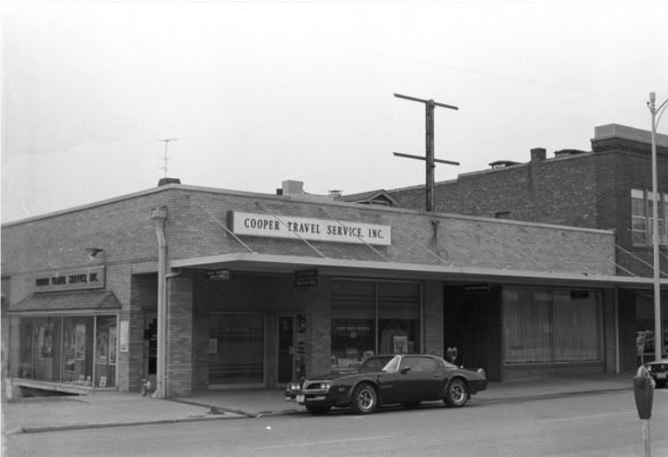
1978 photo of Cooper Travel, formerly Kroger grocery, courtesy of the State Historical
Society of Missouri
The block of South 8th between Cherry and Locust was never a stagnant collection of brick and mortar; it was a living, breathing machine of adaptation. Some structures proved their resilience for over a century. By 2014, the demolition of the F. P. Miller building and the former Kroger grocery store to make way for the District Flats signaled a shift toward a single-use density that erased the intricate, industrial DNA of this section of the Avenue.
In our final segment of this series, we will investigate the history of the Avenue of the Columns from Locust Street to Elm Street, ending at the iconic columns of the old Mizzou Academic Hall.
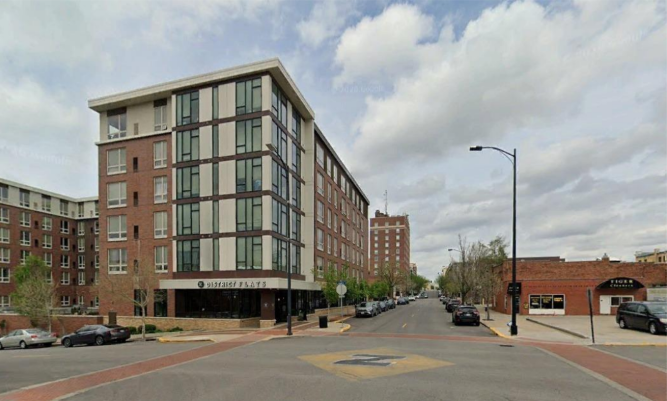
Image looking north up South 8th Street from Locust courtesy of Google Earth.
