Candlelight Lodge
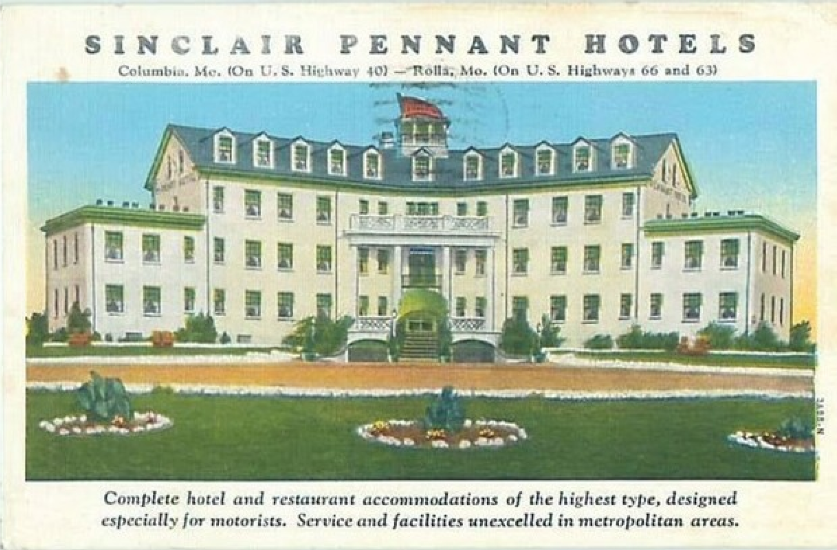
Postcard courtesy of the State Historical Society of Missouri.
Candlelight Lodge located at 1406 Business Loop 70 West, originally known as the Pierce Pennant Motor Hotel, is a significant surviving example of an early hotel/motel built in 1929 in a specific response to burgeoning automobile travel. It is a good example of the Williamsburg Restoration or Revival style of architecture, which is a subcategory of the broader Colonial Revival style. The style was sparked by the high- profile restoration of Colonial Williamsburg in Virginia, which began in 1926 and was funded by John D. Rockefeller, Jr. The hotel and grounds were designed to look like a grand colonial estate.
The Pierce Petroleum Company was one of the first oil companies in the United States. The Pierce Pennant complex in Columbia, consisting of a terminal building, a hotel and garage, and a service station, was intended by the Pierce company to be one of a string of such facilities located every 125-150 miles between New York and San Francisco. While most motels in that era were merely groups of cabins on busy highways, the Pierce company aimed to provide the ultimate in comfort and service. Sadly, the onset of the Great Depression shortly after the opening of the Pierce Pennant deprived the hotel of a fair opportunity to demonstrate it was what the traveling public wanted.
The hotel was attractive architecturally, set in spacious, landscaped grounds and was of fireproof construction. It was designed as a show piece as well as a source of potential profit. An important feature of the hotel was the underground garage, where guests could leave their cars with the assurance that the vehicles and their contents would be safe. The restaurant in the terminal building, serving excellent food at reasonable prices, made it unnecessary for guests to go into town for their meals.
In the terminal building there was an emergency hospital with a trained nurse on hand. Ambulance service to local hospitals and doctors/ offices were available. An information booth was provided and Western Union as well as long-distance and local telephone lines were installed. Repair and maintenance work on cars was provided on a twenty-four basis in the service station.
The hotel opened in 1929, the same year the stock market crashed. The ambitious plan to build hotels every 125-150 miles from New York to San Francisco vanished as the economy collapsed. In 1930, just one year after the hotel opened, the Pierce Petroleum Company was bought out by the Sinclair Refining Company. Sinclair was interested in Pierce’s oil assets and gas stations, not in running a luxury “motor hotel” chain. They rebranded the existing hotels as “Sinclair-Pennant” but abandoned the nationwide expansion plan.
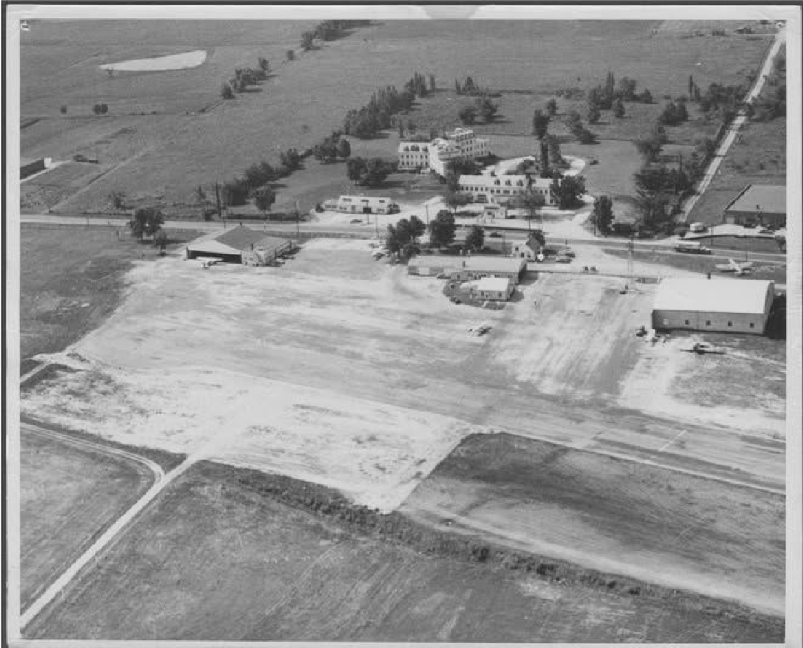
Photo, circa 1940, looking south at the Columbia Municipal Airport and the Pierce Pennant Complex. Courtesy of the State Historical Society of Missouri.
On 7 December 1941, Harry S. Truman, then a U.S. Senator, was staying at the hotel. Truman had been traveling across Missouri and had checked into the hotel which was conveniently located on Highway 40 right across the street from the municipal airport. He was reportedly taking a nap in his room when he was awoken by a phone call (some accounts say it was a telegram or a frantic knock at the door by a staff member) informing him of the surprise attack on Pearl Harbor. He caught a flight from the municipal airport back to Washington, D.C., to join the emergency session of Congress, where he would vote for the declaration of war against Japan.
During World War II, the complex was leased to Stephens College. It served as a dormitory and training facility for women pilots nicknamed Flying Susies and ground personnel (part of the Civilian Pilot Training Program), using the Pierce Pennant buildings and the runways and hangars of the Columbia municipal airport which was just across Highway 40. It has been estimated that as of 1955, approximately ten percent of the nation’s women aviators had received their training at Stephens College.
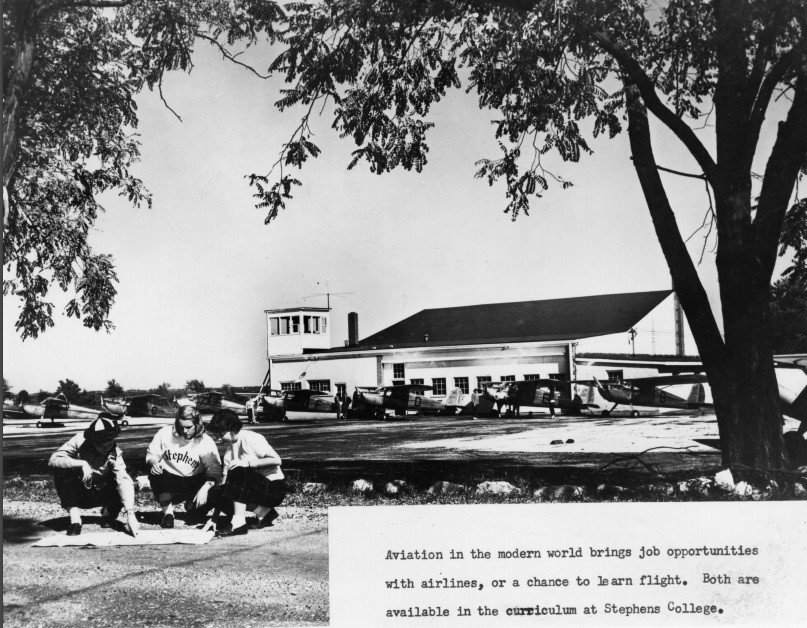
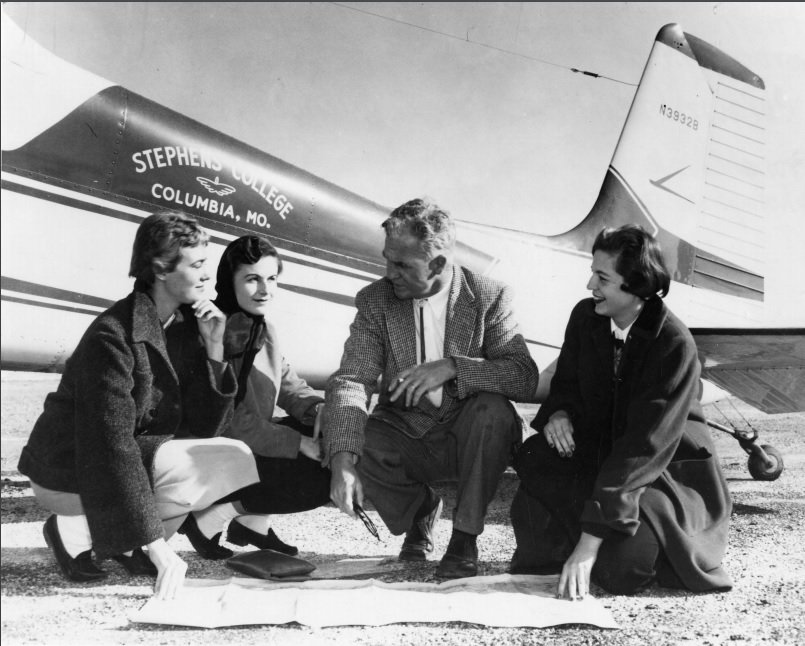
Photos of “Flying Susies”—Stephens College aviation students, both courtesy of the National Register of Historic Places Inventory Nomination Form 82003125 for the Pierce Pennant Motor Hotel, United States Department of the Interior, Heritage Conservation and Recreation Service, National Archive Catalog.
The building eventually ceased operating as a hotel and in 1959 it was converted into Candlelight Lodge, an assisted living and retirement facility. The timing of the conversion was not a coincidence. By the late 1950s, U.S. Highway I-70 was being built to the south of Old Highway 40, effectively bypassing the hotel, which meant the hotel was no longer on the primary path for cross-country travelers. The transition to a retirement home helped save the building because the facility required a quiet, residential atmosphere, inspiring the owners to maintain the original architecture and formal landscaping.
The Pierce Pennant Motor Hotel was placed on the National Register of Historic Places in 1982 and designated a Most Notable Property by the City of Columbia in 1999, just one year after the Columbia Historic Preservation Commission established the program. Even with these honors, a “Most Notable Property” or a “National Register of Historic Places” designation does not prevent the owner from demolishing the property. Candlelight Lodge officially closed and declared Chapter 11 bankruptcy in 2022. The building currently sits vacant, leading to recent local discussions about its future and the need for a new developer to step in and hopefully utilize its historic tax credits for a new purpose.
SOURCES:
State Historical Society of Missouri
National Register of Historic Places Nomination Form 82003125
National Archives (NARA) Catalog, Record Group 79
City of Columbia Historic Preservation Commission
The Accidental President: Harry S. Truman and the Four Months that changed the World by A.J. Baime
CoMo Preservation is devoted to helping homeowners, landlords, and institutions prevent the destruction of historic architecture. Original period styles might be replicated but will forever lack the social history of authentic structures. Preserving historic places and spaces gives people a sense of place and boosts Columbia’s economy. You can get involved by volunteering, signing up for our mailing list, attending an event, becoming a member, or donating.
