
The 1823 Todd House: The Lost Lincoln Connection
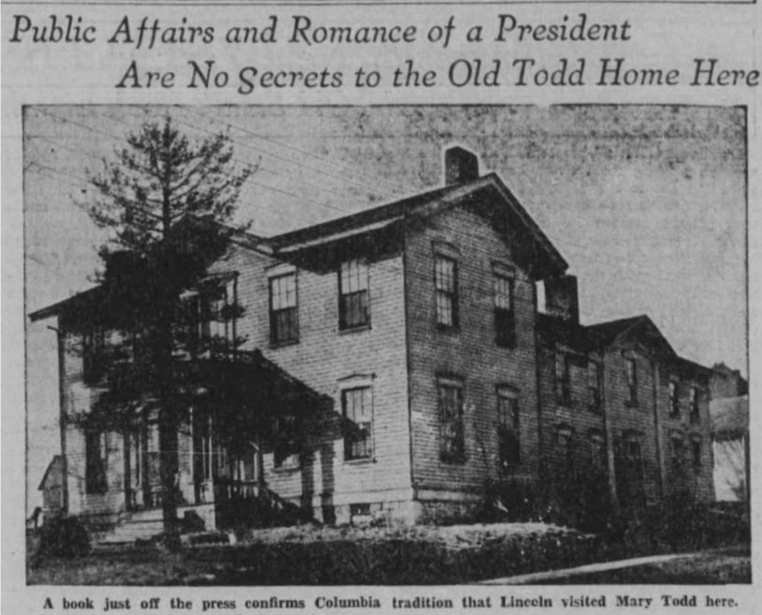
Clipping from the 16 February 1929 Columbia Missourian.
Thousands of Columbians pass the southwest corner of Broadway and Providence Road every day. Today, it is defined by a bustling Walgreens, paved parking, and the steady hum of modern downtown traffic. But if you could step back two centuries, the landscape looked vastly different
Standing on an elevated plot overlooking what was then the intersection of Broadway and Third Street stood one of Boone County’s earliest and most historically significant residences: the Roger North Todd House. Built in 1823, it was a silent witness to Columbia’s transition from a frontier outpost to a thriving university town—and the site of a cherished local connection to an American president
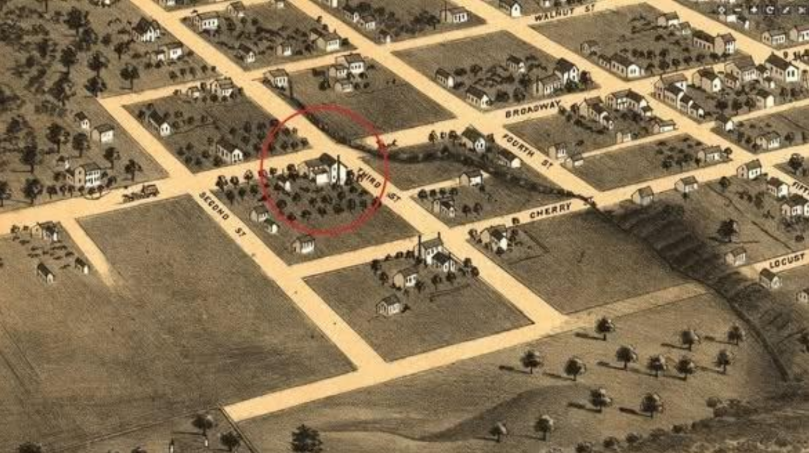
The Todd house circled in red on “A Bird’s Eye View of Columbia, Missouri – Circa 1869,” by Albert Ruger.
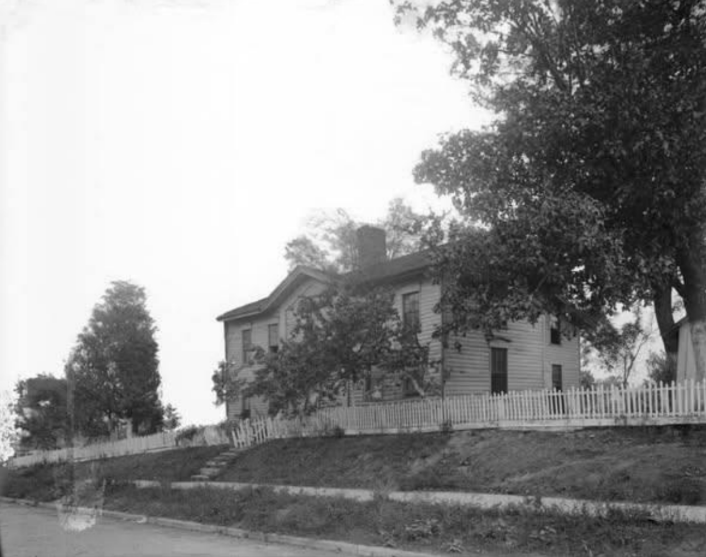
Circa 1916 photo from “The Bench and Bar of Boone County, Missouri”
by North Todd Gentry.
When Roger North Todd (1797–1846) constructed his home in 1823, Columbia was barely two years old. As the first circuit clerk and recorder of Boone County, Todd didn't just live in the home; he maintained his official clerk’s office within its walls, making the residence an early focal point of local civic and legal affairs.
Architecturally, the house told a fascinating story of growth and adaptation:
The structure reportedly began as a heavy-timbered log cabin, typical of early Missouri frontier construction designed for immediate durability and shelter. It faced Broadway. At some point, the Todd family expanded and weatherboarded the house, converting it into a formal two-story I-house still facing Broadway.
Around mid-century, the new owner Col. Francis T. Russell (1821-1891) added a two-story addition in the form of another I-house on the east side facing Third Street. The I-house was a popular 19th-century vernacular form characterized by its two-story height, side-gabled roof, symmetrical front facade, and central hallway floor plan (traditionally one room deep, two rooms wide plus hallway).
This practice of "building around" an original log cabin was a defining architectural trend of mid-19th-century Missouri. As families prospered and building materials like milled lumber became widely available, encasing an earlier log cabin allowed homeowners to gain prestige and modern space while retaining the sturdy timber backbone of their original homestead.
Beyond its civic and architectural significance, the Todd house holds a unique place in Columbia lore. Roger North Todd was the uncle of Mary Todd Lincoln. According to a niece of Mary Todd Lincoln, Katherine Helm, a young Mary Todd—then living in Springfield, Illinois—visited her uncle’s family in Columbia in 1840. Miss Helm wrote in her book, “The True Story of Mary, Wife of Lincoln”, that Abraham Lincoln traveled to Columbia during this period, visiting the Todd home on Broadway to court his future wife.
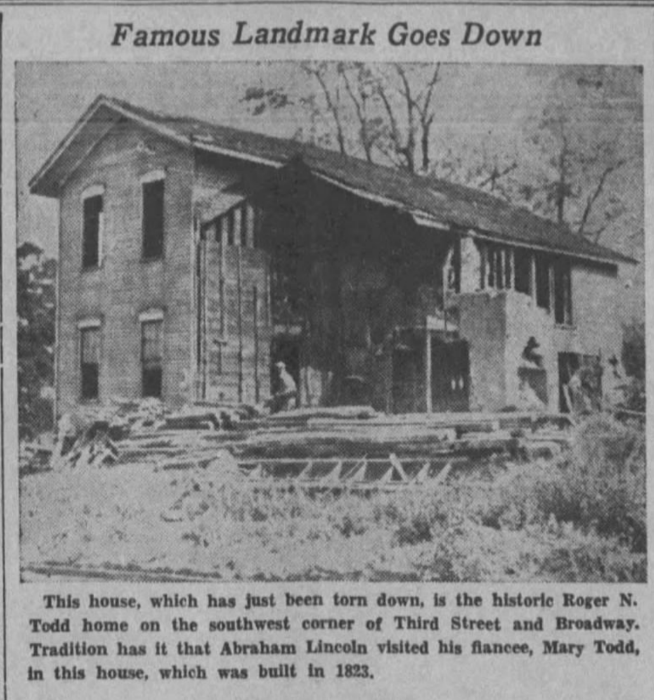
Clipping from the 15 September 1936 Columbia Missourian.
By the early 20th century, as the automobile began reshaping American cities, downtown thoroughfares were increasingly converted from residential corridors into commercial districts. Historic homes along Broadway faced growing pressure from commercial development. On September 15, 1936, the Columbia Missourian recorded the end of the line for the more than 100-year-old landmark. The house was torn down to clear the lot for commercial expansion, bringing an abrupt close to more than a century of continuous history on that corner. The loss of the Todd house was a classic example of early 20th-century urban turnover—a period before formal historic preservation movements existed to advocate for adaptive reuse or structural protection.
When a physical building is destroyed, its story doesn't have to vanish with it. Through archival mapping—such as the Bird’s-Eye View map of Columbia created by Albert Ruger in 1869—and early photographic records preserved in newspapers and local historical collections, we can reconstruct the visual lineage of our streets. The story of the Roger North Todd house serves as an important reminder of CoMo Preservation’s core mission: to understand why we preserve what remains, we must look closely at what we have already lost. Every historic structure surviving in Columbia today represents a bridge to our collective past. By documenting lost landmarks like the Todd House, we honor the intricate layers of Columbia’s history—and strengthen our resolve to protect the historic places that still stand.
Sources:
• Columbia Missourian, "Famous Landmark Goes Down," September 15, 1936, pg 3.
• Columbia Missourian, “Public Affairs and Romance of a President are no secrets to the Old Todd Home Here”, February 16, 1929, pg 13.
• Gentry, North Todd. The Bench and Bar of Boone County, Missouri.
• Dalton, Warren R. Jr & James David A. The Writings of North Todd Gentry.
• Helm, Katherine. The True Story of Mary, Wife of Lincoln.
• Ruger, Albert. A Bird’s-Eye View of Columbia, MO – Circa 1869.
• Switzler, William F. History of Boone County, Missouri.
CoMo Preservation is devoted to helping homeowners, landlords, and institutions prevent the destruction of historic architecture. Original period styles might be replicated but will forever lack the social history of authentic structures. Preserving historic places and spaces gives people a sense of place and boosts Columbia’s economy. You can get involved by volunteering, signing up for our mailing list, attending an event, becoming a member, or donating.
