
Avenue of the Columns: Part Two of Four
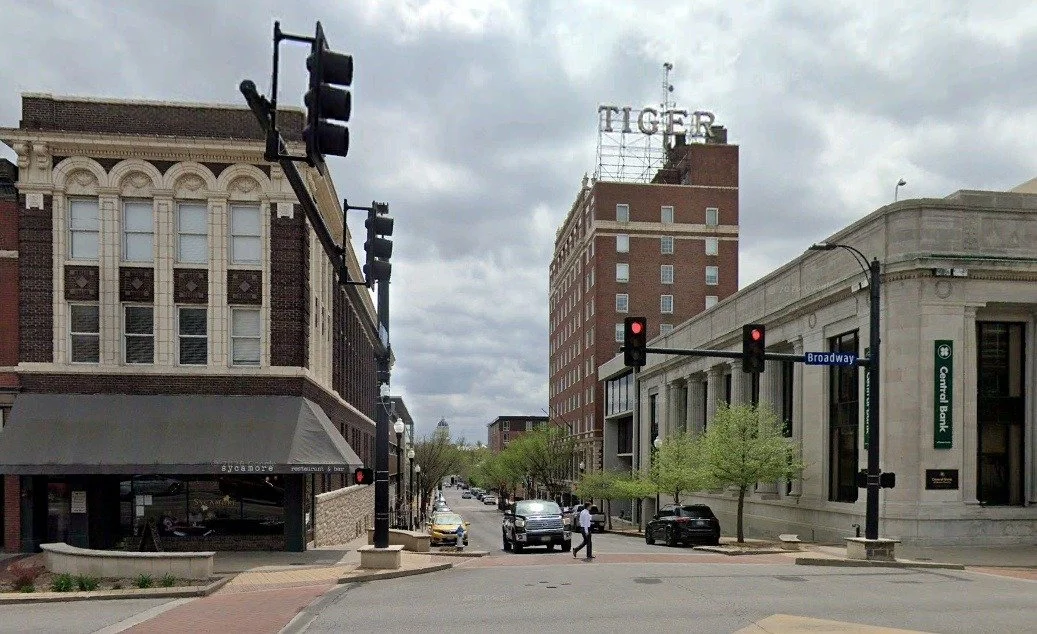
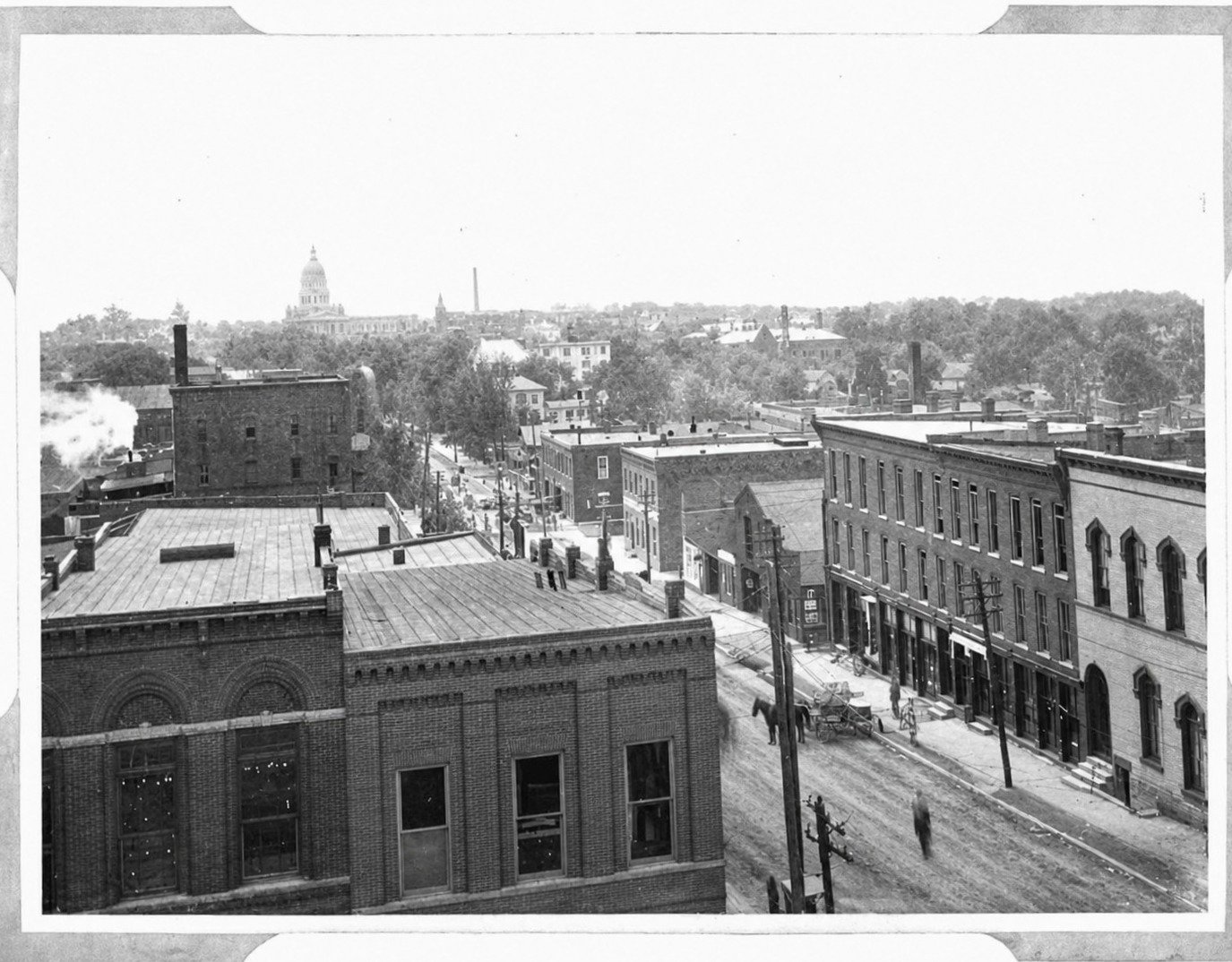
Photo 1 courtesy of Google Earth. Photo 2, circa 1910, courtesy of the State Historical Society of Missouri.
In the 19th century, the stretch of South 8th Street from Broadway to Elm Street was known as University Street, not to be confused with today’s University Avenue. During the Civil War, a citizen’s guard company that called itself the “Columbia Tigers” built a small log blockhouse with portholes at the intersection of Broadway and University Street. “In this position it commands Broadway throughout its entire length and University Steet running north and south”, the Statesman would report when it resumed publication after the war. “It would be a serviceable fortification in case of attack.” With the town’s defenses behind us, let’s march further down the first block of 8th Street south of Broadway.
The southeast corner of Broadway and 8th Street witnessed a lot of Columbia history. In 1843, this was the site of a dry goods store owned by James Leachman Stephens (1815- 1902), one of the most resourceful of all the town’s merchants and for whom Stephens College is named. On 5 October 1850, a catastrophic explosion—reportedly caused by a cigar ash thrown on a leaky keg of gunpowder—destroyed the brick building and claimed several lives. Stephens’ survival was deemed miraculous; shielded by a sturdy counter, he emerged from the debris uninjured. He quickly rebuilt, and by 1883, Sanborn Fire Insurance maps show another two-story brick dry goods store on the site. From 1902 through 1908, that building housed a grocery store.
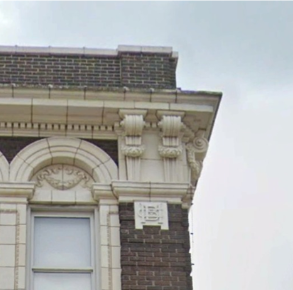
Image courtesy of Google Earth.
In 1910, Charles Ballentine Miller (1865-1924) commissioned the current structure. A prominent shoe and boot merchant, Miller’s initials (“CBM”) remain stylized in terra cotta at the building’s top corners. Miller had arrived in Columbia at age 12, eventually purchasing the building at 823 E. Broadway (current home of My Secret Garden) where he operated his shoe business until 1910. The three-story brick Miller Building is one of downtown’s most architecturally significant landmarks, featuring a stunning terra cotta façade, round-arched windows with garland motifs, and decorative supports beneath a substantial cornice. Miller operated his business here until his death in 1924, and his family retained ownership until 1978. Today, the beautifully restored space is home to the Sycamore restaurant.
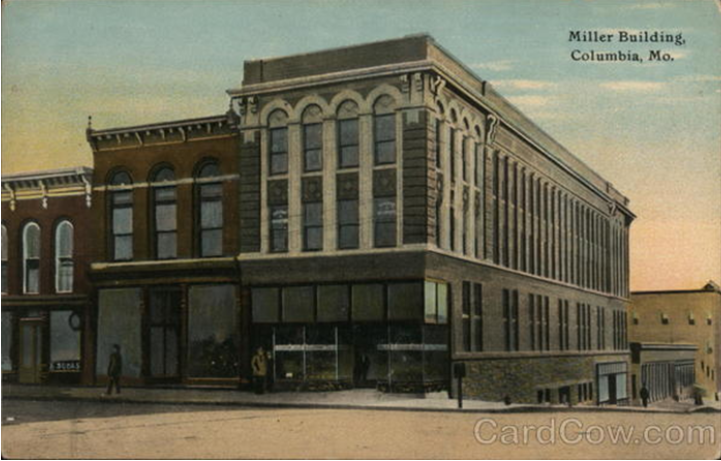
Postcard courtesy of CardCow.com.
The Miller building extends halfway down the east side of South 8th Street to the alley, mirroring the footprint of previous structures. Over the decades, these South 8th Street store fronts hosted a rotation of local trades. Sanborn maps from 1883 to 1908 reveal a meat market at 10 South 8th Street, while the next storefront south hosted a grocery, followed by a cobbler, and finally a barber.
By 1914, a barber remained at 10 South 8th, joined by the Western Union Telegraph Company at 12 South 8th. The upper floors of the Miller building functioned as a social and professional hub, with twelve offices on the second floor and a lodge hall on the third. By 1925, Western Union had expanded to occupy both storefronts. Meanwhile, the building’s substantial Boone County stone walkout basement was largely occupied by the printing operations of William Hirth (1875-1940) for his publication, The Missouri Farmer (the future official magazine of the MFA).
Continuing south past the alley, we encounter a site that literally provided the “bones” of early Columbia. From 1863 to 1929, the southern half of this block was occupied by the McAlester and Bowling lumber yard. The partnership between Brightberry McAlester (1809-1902) and James Bowling (1797-1886) was a cornerstone of local industry. In addition, Brightberry McAlester was the father of Dr. Andrew McAlester (1841-1922), the “Father of Mizzou’s School of Medicine”— a family legacy that encompassed both the city’s skyline and its health.
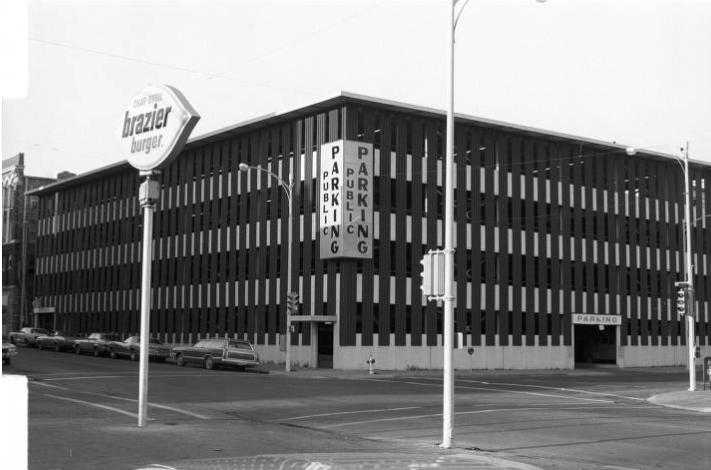
1978 photo courtesy of the State Historical Society of Missouri.
As the business passed to Brightberry’s son-in-law James Davis Bowling (1831-1913), the yard evolved alongside the times. The original frame structures were replaced with brick, and the company’s inventory grew to include the high-tech transport of the day: carriages and farm implements. By 1925, in a final nod to the changing era, part of the site even served as a lot for second-hand automobiles. When the company relocated in 1929, the site fell quiet, eventually serving as storage until the historic buildings were razed in 1945. Today, the space serves a modern mechanical need; where carriages and early Fords once sat for sale, a parking garage now stands, replacing an earlier parking garage.
The southwest corner of Broadway and 8th Street has mirrored Columbia’s evolution from a frontier town to a financial hub. Before 1883, a two-story Italianate brick structure stood here, housing a rotating cast of tenants including a dry goods store, a hardware store, and even the local post office. From 1902 to 1925, Gillespie’s Drug Store anchored the corner, while the 8th Street side down to the alley hummed with the industrial clatter of blacksmith shops, carriage factories, and harness shops. By 1916, most were razed to make way for the Boone County National Bank, now known as the Central Bank of Boone County.
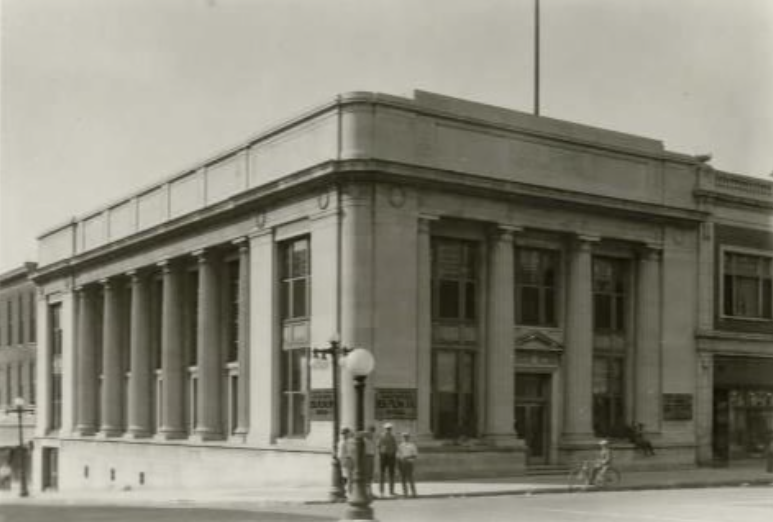
Photo, circa 1927, courtesy of the State Historical Society of Missouri
Founder Robert Beverly Price (1832–1924), a Virginia native who entered Mizzou in 1850 at the age of 18, established the bank in 1857. Besides founding the bank, which was the first bank in Missouri to be established under the national banking system, Price was an ardent supporter of the University of Missouri. He was the treasurer of Mizzou for fifty years. Originally located in a building on the northeast corner of 8th and Broadway, the bank moved across the street in 1917 into a grand Classical Revival structure.
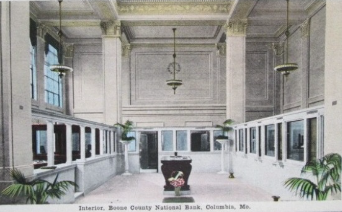
Postcard courtesy of the State Historical Society of Missouri.
A 1917 Missourian supplement detailed the bank’s staggering opulence. Built of Missouri Carthage stone, the entry featured $500 solid bronze doors. Inside, the lobby was a temple of luxury: pink Tennessee marble floors bordered in French grey, walls of creamy travertine, and a 24-foot ceiling decorated with gold-touched plaster leaves. A massive stained-glass skylight was supported by four Greek-style columns and surrounded by a processional of winged lions. Even the amenities were elite, featuring a black walnut-paneled men’s room with a fireplace and a women’s lounge furnished with wicker desks and mirrors.
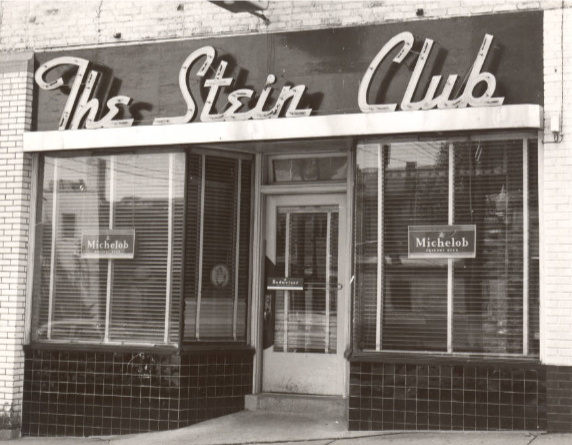
Photo of Stein Club, circa 1956, courtesy of the Fity.com.
The mid-century brought a wave of modernization that stripped away much of this grandeur. A 1958 remodel lowered the ceiling to add a partial second floor, hiding the skylight. In 1964, a complete interior overhaul by Pan Chinn and James Darrough removed almost all original decorative features, including the bronze doors. The bank then pushed south and west. In 1967, a four-story addition to the south was begun to accommodate the bank’s growing needs. This expansion necessitated the demolition of an older brick structure, the original home of the legendary Stein Club. For years, the club had served as a favorite gathering spot for college students, tourists and locals before making way for the bank’s new “Fountain Lobby” and garden terrace. The Stein Club moved to 704 E. Broadway, retaining its famous neon sign. In 1983, the bank acquired the adjacent Parks Department Store to the west on Broadway, eventually adding a third floor in 1986 and a fourth in 1992, creating the expansive complex that defines the bank today.
South of the alley toward Locust Street, the western side of 8th Street was defined by nearly a century of livery, feed, and livestock businesses. This era was marked by the 1870s fire that destroyed the stable of John D. Van Horn (1821–1886), giving rise to a tongue-in-cheek local legend: “The horses went north and the rats went to the University.” By 1925, these stables had evolved into a filling station and oil racks, which were cleared in 1927 to make way for a bold new skyline—the Tiger Hotel.
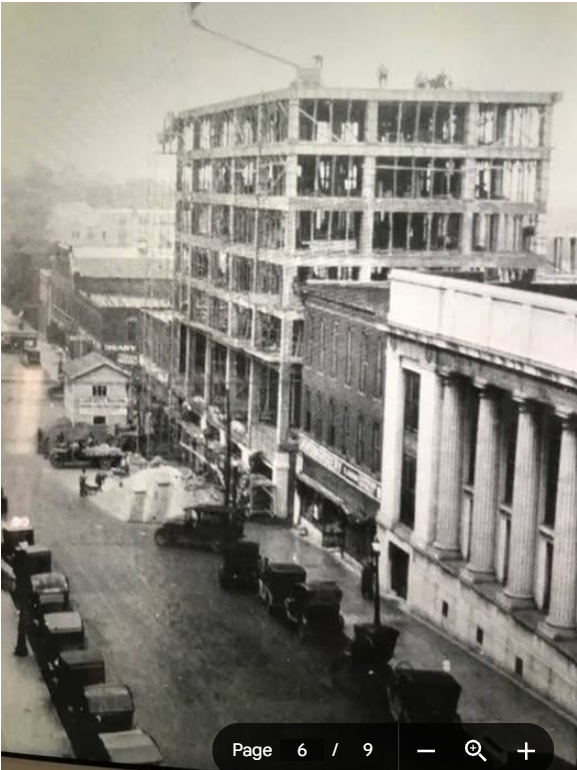
Circa 1927 photo courtesy of the State Historical Society of Missouri.
Designed by Alonzo Gentry and built by the Simon Construction Company, the Tiger Hotel became the city’s most lavish landmark and one of the first true “skyscrapers” between St. Louis and Kansas City. Its construction was a public spectacle, with locals gathering to watch materials hoisted ten stories high. The hotel set a new standard for luxury, boasting over 100 rooms, elevators, and a cutting-edge circulating ice water cooling system. Today, the “Tiger” sign atop the roof remains one of Columbia’s most iconic beacons.
The Tiger Hotel is the only historic hotel in Columbia to survive with its original integrity nearly intact. Faced in red brick and cream-colored terra cotta, the exterior features stone-accented corners and windows capped with intricate terra-cotta keystones embellished with female heads. Lavish cartouches and large ornamental urns provide a crowning touch to the structure’s facade.
Inside, the twenty-foot lobby ceilings and maple paneling retain their 1920s grandeur. The space is dominated by large piers featuring applied tiger heads and illuminated by original stained-glass fixtures and a central chandelier. On the mezzanine, the ballroom preserves its fifteen-foot ceilings, elaborate moldings, crystal chandeliers, and original oak parquet floors.
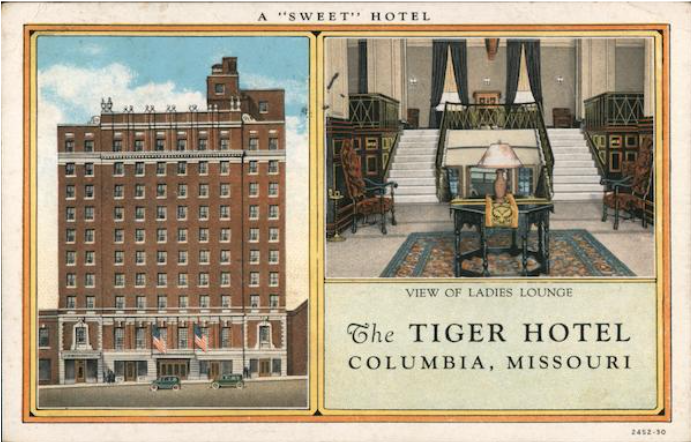
Postcard courtesy of CardCow.com.
As rail travel gave way to the automobile age, the building was reinvented as the Tiger Motor Hotel, featuring an “automatic garage” for guests. When interstate travel bypassed downtown, the building transitioned again in 1987 into a retirement community known as The Kensington. However, its historical significance never wavered; it was nominated for the National Register of Historic Places in 1979 and named one of Boone County’s top ten notable places in 2000. Following a magnificent 2011 restoration, the Tiger Hotel has returned to its roots as a premier destination, once again serving as a leader in hospitality and a symbol of downtown excellence.
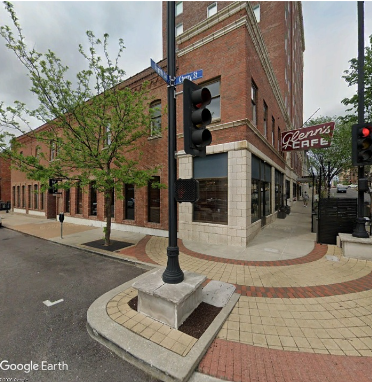
Image courtesy of Google Earth.
While the Tiger Hotel reached for the clouds, the two-story brick building on the southwest corner of 8th and Cherry kept its feet firmly on the ground. Long before it became the home of the renowned Glenn’s Cafe, this structure was a center of commerce. Appearing on the 1908 Sanborn map, it was the home of Payne-Roth Wholesale Grocers. A long wooden porch on the south side along Locust Street was a bustling loading dock where wagons unloaded the region’s harvest in the shade of the building. It stood its ground during the construction of the hotel in 1927 and remains today as a bridge between the street’s industrial past and its sophisticated present.
Standing at the corner of 8th and Cherry looking north, the view encapsulates the restless spirit of Columbia’s growth. In a single city block, we walked past the site of a Civil War blockhouse, the site of a pioneer lumber yard, the elegant expansion of a local banking empire, and the city’s first ten-story skyscraper. This stretch of the Avenue of the Columns illustrates that history is rarely a straight line; it is a layered map of holdout grocery stores, iconic neon signs, and shifting industries. Having explored the sophisticated heart of 8th Street, we look south toward the next block where almost all the original buildings are gone but we will recreate them in the next installment of Avenue of the Columns.
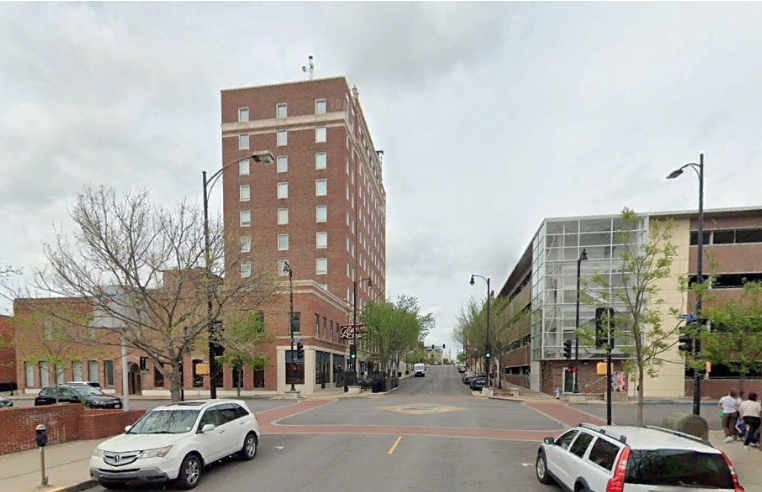
Looking north at 8th and Cherry; image courtesy of Google Earth
Sources:
1978 Historic Inventory of Columbia, MO
State Historical Society of Missouri
Sanborn Fire Insurance Maps
Google Earth
CoMo Preservation is devoted to helping homeowners, landlords, and institutions prevent the destruction of historic architecture. Original period styles might be replicated but will forever lack the social history of authentic structures. Preserving historic places and spaces gives people a sense of place and boosts Columbia’s economy. You can get involved by volunteering, signing up for our mailing list, attending an event, becoming a member, or donating.
